Traps to Avoid on a Shanghai Team Retreat
The traps on a Shanghai team retreat are not on site: they are in the drive time, the headcount arithmetic, the events policy and the check-in hour. Backed by 100 verified whole-house properties near Moganshan, where 84 allow events but only 20 allow noise after 23:00.
1. Where the traps are: most are set before you leave
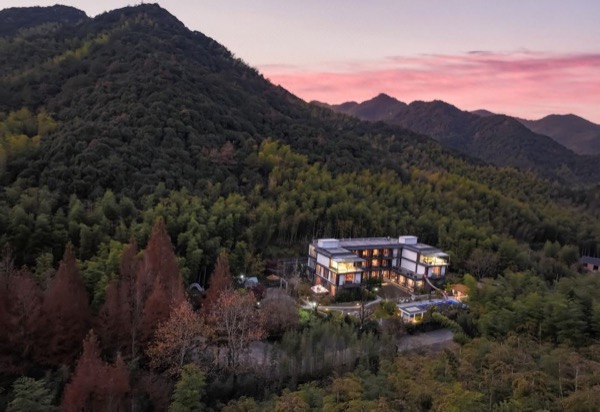
Answers to "team retreat around Shanghai" run from a city restaurant to a mountain guesthouse. By one-way drive time there are only three rings, and each has a different ceiling: the city ring (0–1 hour) has the most choice and no overnight; the near ring (1.5–2 hours — Chongming, Qingpu, Jinshan, Lingang) allows overnight but mostly sells resort rooms by the unit, with whole-house supply scattered and small; the outer ring (2.5–3 hours) is Moganshan, the densest whole-house supply in the Yangtze Delta, and all 100 properties we verified sit there.
The traps do not wait until you arrive. Across these 100 properties the recurring disputes trace back to three moments: before departure (drive time and headcount miscalculated), before payment (policy never pinned down to a number), and on arrival (the courtyard is not yours, and quiet hour starts at nine). This article follows that order and gives the question to ask at each step.
2. Trap one: estimating drive time by straight-line distance, and believing the one-hour train
From Shanghai the 100 properties sit 156 to 177 km in a straight line, median 167 km, or 2.5 to 3 hours by road. You cannot divide distance by speed: the correct budget is motorway distance divided by motorway speed, plus a fixed 30 to 40 minutes for the mountain section. The motorway ends at Deqing and the final stretch is all switchbacks averaging 30 km/h — which is why Hangzhou, only 44 km away in a straight line, still takes 1.5 hours.
The other widespread error is "one hour by high-speed rail from Shanghai". That hour lands you at Deqing station; the town is another 15 to 20 km and 25 to 30 minutes. Add station access and waiting and the door-to-door figure is over three hours, with no car at the far end and a transfer to arrange. For a group, a direct coach is usually simpler than rail.
- Budget the city exit separately. On Saturday mornings the Shanghai–Hangzhou corridor jams; leaving at 7:00 versus 9:00 can mean a two-hour difference on arrival.
- Do not navigate to "Moganshan Scenic Area". Use the property name or Yucun village; there is a checkpoint at the foot of the mountain that turns back non-resident vehicles.
- Ask about the coach separately. Can it reach the door, how many bays — 100% of these properties offer free parking, but that figure is for cars.
3. Trap two: "sleeps 20" is a bed count, not an event capacity
Every "sleeps N" figure is the headcount with every bed filled, not the number of people who can do something in one room together. The gap only bites in small buildings: a 400 sqm house with ten rooms can claim 20 beds while offering nowhere for 20 people to sit together — you have booked a row of bedrooms, not a venue.
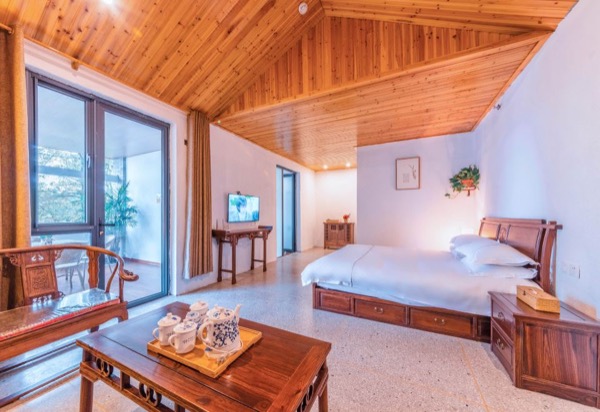
Room allocation is the second trap. 24 properties have not a single room with two single beds; every unit is a double or a single, so pairing two colleagues in one room simply does not work there, and extra beds become the only answer. A further 28 properties do not allow extra beds at all, so the headcount must stay strictly under the cap. The question to ask is not "how many does it sleep" but "how many bedrooms, and how many have two single beds".
4. Trap three (the most valuable one): events allowed does not mean events allowed until when
Eighty-four properties explicitly allow events, and most organisers stop asking there. What actually decides the evening is a second field: quiet hours. Across those 84 the split is 25 with quiet from 22:00, 17 from 23:00, 9 from 21:00, 3 marked 00:00 (effectively unlimited), and 24 with no quiet clause at all. Permission to hold an event and permission to keep making noise at 23:30 are two different permissions.
Stack the two conditions and the number collapses: only 20 properties both allow events and permit noise after 23:00 (17 plus 3). Split by capacity and the result inverts intuition — 9 sleep 10 to 19, 7 sleep 20 to 29, 1 sleeps 30 to 39, and none sleeps 40 or more. In other words, the larger the group, the harder it is to find a house that can host a late party. The reason is structural: houses above forty beds tend to sit in the core of the resort area, where neighbours are close and owners will not put a late-hour permission in writing.
- "Between which hours must we be quiet?" — ask for a range, not whether quiet hours exist.
- Six properties have a quiet-hour field filled with daytime times (10:00, 11:00, 20:00 and so on), almost certainly a policy line such as "please keep quiet from X to Y" parsed as a single point. Which is exactly why this field must be read in the original wording, never as a conclusion.
- "We are 20 people and need to run until 22:30 — can that clause flex?" — a specific time is a question a host can answer.
5. Trap four: you reach the foot of the mountain at eleven, the rooms open at two
99 properties release rooms at 14:00 or later — 81 state 14:00, 13 give a check-in window starting at 14:00 and 5 only from 15:00 — with a single exception from 09:00. Check-out is harder still: 98 require the keys back before 12:00, the earliest at 07:30, and exactly one allows 13:00. So a "one-night stay" is really Saturday 14:00 to Sunday 12:00 — 22 hours. You pay for a building; you use one continuous block of 22 hours.
A Shanghai group typically reaches the foot of the mountain between 10:30 and 11:00, and those three hours are time with somewhere to stand but no room to use. 95 properties store luggage, but storage is not access: the living room, kitchen and courtyard are mid-way between one group leaving and the next arriving. Only two plans are safe for that first morning — eat lunch on the road, or put the scenic area or a hike in that slot (entry requires the Yucun transfer centre, controlled hours 8:00–17:30).
6. To be honest: six cases where a Shanghai team should not come
Everything above is the case for it. This section is the case against. In these situations the trip is not a compromise, it is structurally wrong, and the team will remind you afterwards.
- Under 15 people. A whole house is priced per building, so the base cost does not spread, per-head cost beats a city hotel, and you never use the several hundred square metres of living room and courtyard.
- Half a day, same-day return. Five to six hours of driving for four hours of activity is negative value, and you still drive home in the dark.
- Someone cannot handle a long ride. The last 30 to 40 minutes are steep switchbacks; the carsick, the pregnant, the bad back and the parents of toddlers will be ruled out by that stretch alone.
- A tight budget. Transport is on top, and a 50-seat coach return is not a small line item; the total usually exceeds a city plan.
- The goal is dinner and karaoke. The city does it fully, with no parking or check-out to coordinate.
- Under 20 people who only want one night somewhere else. The near ring is better value — Moganshan wins on the density of whole-house supply, which a small group cannot use, and the extra hour of driving is pure cost.
7. When it is the best option, and what to book at each size
Flip the conditions and there is little competition: 20 to 40 people, two days and one night, everyone under one roof, and a programme with cooking, grilling, an awards session or a long conversation — anything needing everyone present and no outsiders walking through. In our data 84 properties explicitly allow events, 86 can host a barbecue, 42 have a kitchen, 71 have a mahjong room, 56 have KTV or a media room, and 100% offer free parking.
By headcount, match your group directly — and note the second figure in each line, the number that can still make noise after 23:00, because that is the one that decides whether the evening works:
- 10–19 people: 39 properties, the widest tier; but only 9 of them allow noise past 23:00, under a quarter.
- 20–29 people: 42 properties, the thickest supply and the best value. Filter first on events allowed plus a kitchen or restaurant.
- 30–39 people: only 7 properties, and only 1 allows events plus noise past 23:00. Either accept a 22:00 finish, or book from the 40-person tier.
- 40 or more: 12 properties, none of which supports an event past 23:00 in writing. Move the party before dinner, or split into two buildings.
8. Eight questions to turn into numbers before you call
The cheapest way to avoid these traps is to convert every claim into a checkable number or range before paying. These eight can be read aloud; whichever one goes unanswered is your risk.
- "Between which hours must we be quiet?" (84 allow events; only 20 allow noise past 23:00.)
- "How many bedrooms, and how many have two single beds? How would you room our group?" (24 have no twin room at all.)
- "Can we drop luggage before 14:00, and how long may we stay after check-out?" (99 release rooms at 14:00 or later; 98 hold a 12:00 check-out.)
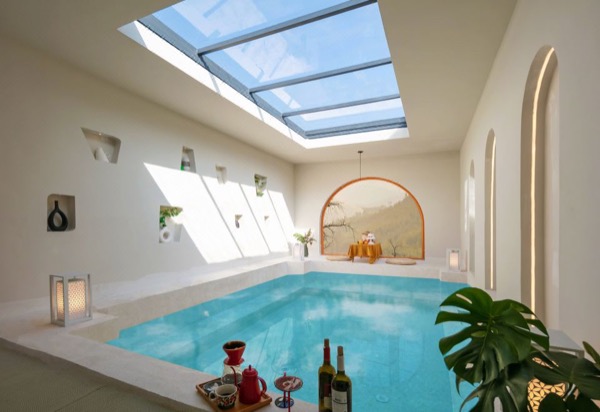
- "Are the courtyard, pool and grill area exclusively ours that day? Does the owner live on site?"
- "Can a coach reach the door, and how many parking bays are there?" (Free parking 100%, but that is a car figure.)
- "How many burners in the kitchen, and is there a pot and enough plates for twenty?" (42 have kitchens.)
- "Is there any construction nearby, and are there neighbours?" (Which is usually where the quiet clause comes from.)
- "Can you issue a company fapiao? What is the deposit, and is it refunded on check-out day?"