How to Choose a Venue for a Class Reunion
A reunion needs a table everyone can sit at, beds nobody argues over, and permission to talk past 23:00. Of 100 verified villas: zero list a large table, only 9 mention a living room, 76 have twin rooms, 21 can stay up late.
1. A reunion and a team retreat need different venues
A retreat venue exists to hold activities: a lawn, a karaoke room, a barbecue, something to divide people into groups so that strangers have a task. A reunion is the opposite. People who have not met for ten years do not need to be organised. They need one table to sit down at, and two uninterrupted hours. That difference sets the order of your shortlist: retreats start from the facility list, reunions start from the shared space.
The data shows exactly this gap. Of the 100 properties, 87 have meeting space, 71 have a mahjong room, 56 list karaoke and 89 allow a fire or barbecue — all of them facilities that scatter people. Meanwhile the words for a large table, a long table, a round table, a dining table or a banquet hall appear zero times across the entire dataset. Only 9 properties mention a living room and 3 mention a sofa. The places people actually sit and talk are recorded as terraces (36) and balconies (42), but most of those are small platforms attached to a room, not a shared space for a dozen people.
So the one thing a reunion needs most — a table everyone can sit at — is the one thing a listing never tells you. You have to ask.
2. Settle the headcount, then walk up the capacity steps
Villas here sleep 10 to 75, median 20. Supply is not continuous: 86 properties take 15 or more, 61 take 20 or more, 30 take 25 or more, 19 take 30 or more, 12 take 40 or more, and only 2 take 50 or more.
Reunions have a particular problem: the number always moves. Twenty-eight sign up, twenty-four arrive, two bring a partner and it is twenty-seven. Book against the sign-up number, not against the number you expect to show. Two spare beds cost nothing; two missing beds mean somebody sleeps on a sofa, and only 3 properties record a sofa at all.
One more reality: the 10 to 14 band has just 14 properties, the thinnest in the dataset. A small reunion of seven or eight people either takes a 10-person house or pays for a 20-person one. There is no product sized exactly to eight.
3. The room mix breaks before the facilities do
Divide sleeping capacity by bedroom count. Across the 77 properties with room data, the median is 2.44 people per bedroom, with 5 to 21 bedrooms and a median of 8. In plain terms: a 20-person house has about 8 rooms, so most people will share.
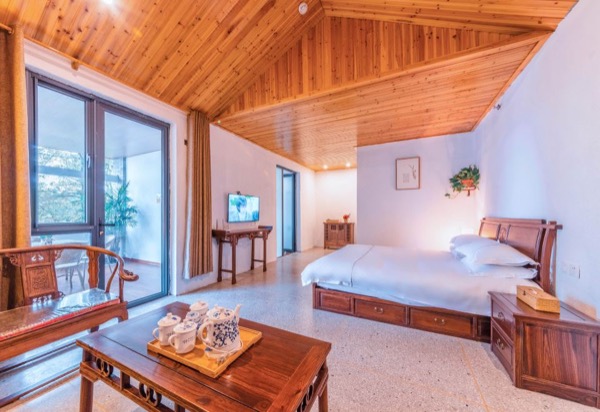
Sharing is harder at a reunion than at a company retreat. Couples want a room to themselves, single friends of the same sex need twin beds, somebody snores, somebody brings a child. Of 895 room types in the dataset, only 76 properties have any room with two single beds, and 18 properties have no single bed anywhere in the house — every room is a 1.8 metre double.
So the second move is not to look at photos. It is to request the room list and draft the sleeping plan first. If the plan works, talk price. If it does not, the prettiest courtyard will turn awkward by ten in the evening.
4. Events allowed and late-night talking are two permissions
The real conversation at a reunion usually starts after 22:00: dinner is over, the children are asleep, the wine has landed, and people finally talk. Quiet-hour rules across the dataset: 38 properties set none at all, 25 start at 22:00, 18 start at 23:00, 9 start at 21:00, 3 start at midnight, and 7 set a daytime window instead.
Eighty-four properties explicitly allow events. Broken down, only 21 of them can carry you past 23:00 (18 at 23:00, 3 at midnight), while 34 must fall silent at 22:00 or earlier. Allowing events is the owner being friendly. The hour they demand quiet is your actual runtime. Ask them as two separate questions or you will only ever hear the first answer.
The reverse also holds: if your reunion is a group of families with small children, those 9 properties with a 21:00 quiet hour become a feature. What wakes a child at night is rarely your table. It is the house next door.
5. Slicing 22 hours: three anchor times
Ninety-nine properties hand over the keys at 14:00 or later, and 98 want them back before 12:00, so one night buys 22 hours. At a reunion that block should be cut into three parts, pinned to three clock times.
- 14:00, keys: whoever arrives first claims the space, sets up the table and chills the drinks. Do not schedule anything here. People rarely all arrive before 16:00.
- 18:00, dinner: the only move that puts every single guest at the same table, and the high point of the trip. Work backwards: plating starts at 17:00, and if you are cooking, somebody is in the kitchen at 15:30.
- 12:00 the next day, keys back: breakfast and packing eat the whole morning. Do not save the real conversation for day two, when half the group is zipping a suitcase or hunting for car keys.
6. Move dinner to 18:00 and you gain two hours
The most common mistake is setting dinner at 20:00. You finish at 21:30, and in a house with a 22:00 quiet hour the evening is over in half an hour. Serve at 18:00 and the same house yields two extra hours. For the 34 properties that fall silent at 22:00 or earlier, it is the only schedule that works.
The meal itself has three routes with very different costs. Forty-two properties have a usable kitchen (58 do not), 82 list a restaurant among their dining facilities, and 46 offer room-service style delivery.
- Cook it yourselves: cheapest, and most likely to become three people in the kitchen while twenty wait in the living room. Shopping is part of the cost — the median drive to Wukang town is 11.4 km and only 29 properties are within 10 km.
- Eat out or book the house restaurant: no washing up, but a table for 20 has to be reserved, and all 4 mentions of a private room in the dataset refer to karaoke rooms. None is a restaurant private dining room.
- Have food delivered: simplest, and it goes cold fastest. Reunion dinners run long, guests are never seated at once, and the second round goes untouched.
7. When not to rent a villa
Renting a whole house buys 22 hours of exclusivity, not a cheap venue. If the reunion is one meal, four or five hours, and everyone drives home afterwards, you are using one sixth of what you paid for.
When the conditions fit, there is no real substitute: 15 to 25 people, one overnight stay, conversation as the main programme. That band alone has 56 properties, the thickest supply on the site, which is why most reunions end up in a rented house. But if any one of the following is true, change the plan:
- Fewer than 10 people will actually come: the smallest property sleeps 10, and the 10 to 14 band holds just 14 houses. Booking one means paying for empty rooms.
- Somebody must drive back the same day, or insists on a hotel in town: book a restaurant that seats 20 in Moganshan town plus a teahouse instead. Far less administration.
- The real purpose is to get some work done: none of the 87 properties with meeting space records a whiteboard, a microphone or a projector. All conferencing hardware comes with you.
8. Eight questions for the booking call
Every judgement above ends up as a question on the phone. The list for a reunion differs from a retreat: it is almost entirely about sitting and sleeping.
- "Is there one table that seats all of us, and can tables be put together?"
- "How large is the shared area, can a dozen of us sit and talk at once, and is there a second indoor space?"
- "What time must we be quiet, and does the same rule cover the yard, the living room and the bedrooms?"
- "How many twin rooms and how many doubles? Can you send me the room list?"
- "Can you add beds, what does it cost, and if not, where do the extra people sleep?"
- "How many hob rings does the kitchen have, what is the cleaning fee, and who takes the rubbish away?"
- "What is the earliest we can get in, and can we come an hour early to set up?"
- "After the 12:00 checkout, how long can we keep using the shared areas?"