Planning a Two-Day Team Retreat from Shanghai
Shanghai to Moganshan is 5.5 hours of driving each way, and the house is yours for 22 hours. Split the 31-hour trip into two working windows, and the plan holds. Backed by stats on 100 whole-house properties: 99 release rooms at 14:00 or later, only 14 state a reception cut-off.
1. Do the arithmetic in hours: 31 hours away, 5.5 usable
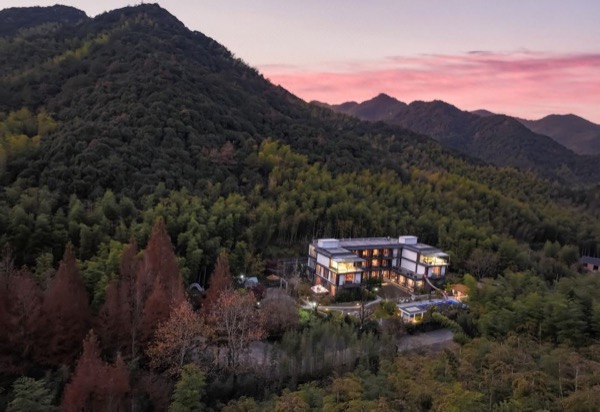
From Shanghai the 100 properties sit 156 to 177 km in a straight line, median 167 km, or 2.5 to 3 hours by road. Run the usual plan: leave Shanghai at 08:00 Saturday, reach the foot of the mountain by 11:00, collect keys at 14:00, check out at 12:00 the next day, home by about 15:00 — 31 hours end to end.
The house is actually yours for 22 hours (14:00 to 12:00). Subtract eight hours of sleep, roughly four hours across two dinners and a breakfast, and 1.5 hours of packing and check-out, and under nine hours remain — and those nine are not contiguous: dinner and quiet hours cut them in two.
So here is the headline: the agenda capacity of a two-day retreat is roughly 5.5 hours — a 3.5-hour afternoon block and a 2-hour after-dinner block. That number sets the ceiling. Two activities that each need everyone for two hours will fill the box completely.
2. When a Shanghai team should not choose Moganshan
Naming the cases where this is the wrong answer is more useful than praising the place. If any one of the five below applies, Moganshan is not the solution — forcing it produces a group that drove six hours and played for two.
- Fewer than 12 people. Whole houses are sold by the night; the cost does not spread, and per-head prices overtake a near-ring resort that sells rooms. A dozen people are better off with a few rooms plus a private dining room.
- You only want three or four hours of eating, singing and cards. A city party house or a restaurant private room does that; there is no reason to spend 5.5 hours of driving on the same thing.
- One day, no overnight. This is the biggest difference from Hangzhou: 44 km and 1.5 hours, so a same-day round trip works. From Shanghai it is 5.5 hours of driving, and 99 properties release rooms at 14:00 or later — a single day is physically impossible.
- A budget under 300 RMB per head. Two days with lodging, food and transport does not fit; forcing it only produces a far house and bad meals.
- Someone with severe motion sickness, pregnancy, or limited mobility. The final 30 to 40 minutes are continuous switchbacks averaging 30 km/h, and there is no way around them. Rule all five out, and only then does Moganshan come into play.
3. Distance is not a filter: across 156 to 177 km you save half an hour
Straight-line distance from People Square to the 100 properties runs 156.3 to 176.8 km, median 166.9 — the nearest and farthest differ by 20.5 km. Almost all of that 20 km sits in the final mountain section at 30 km/h, which converts to under half an hour.
So "pick a closer one" filters out almost nothing for a Shanghai group. What is worth filtering on is whether there is an indoor space that holds everyone on Saturday afternoon, because those 3.5 hours are when mountain weather is least reliable — 87 properties have a meeting or multi-purpose room, but that figure means "people fit", not "equipment exists".
While we are here, retire a widespread claim: "one hour from Shanghai by high-speed rail". That hour lands you at Deqing station; the town is another 15 to 20 km and 25 to 30 minutes. With station access and transfers the door-to-door figure exceeds three hours, and a group of twenty still needs a coach at the far end — one more transfer, one more headcount.
4. Plan two windows, not two days
Quiet hours in the inventory start at 22:00 for 25 properties, 23:00 for 18, 21:00 for 9, 00:00 for 3, with 38 setting none; a further 7 record a daytime hour (10:00, 11:00, 20:00 and similar), which is a "quiet between X and Y" policy flattened into a single point. On the most common and most conservative 22:00 reading, Saturday evening leaves you 20:00 to 22:00.
That leaves exactly two blocks where everyone can be present at once. The schedule is simple, but keep the order: decide what goes in the two windows first, then back-fill eating, lighting the fire and cleaning up.
- 11:00–13:30, the gap: eat lunch in the village and buy the barbecue supplies. 99 properties release rooms at 14:00 or later, so arriving early means waiting at the gate — do not park the whole group in the courtyard for two hours.
- 14:00–14:30: keys, unloading, room allocation announced out loud — not posted in a group chat and assumed read.
- 14:30–17:30, first window: one activity that needs everyone, not three in sequence.
- 18:00 light the fire, 19:00 eat, 20:00 clear up (about 40 person-minutes for twenty people).
- 20:00–22:00, second window: work backwards from the property quiet hour, not from how the evening feels.
- Sunday 07:30–09:00 breakfast and bags; 11:00 assemble, 12:00 check out.
5. Is a Friday-night departure worth it? The blocker is reception, not the road
Leave Shanghai at 18:30 on Friday and the city exit costs you; arrival at the mountain is usually after 22:00. Most people frame this as "will we manage the night drive". The real constraint is at the other end: whether the house takes guests at that hour.
Of the 100 properties, only 14 state a reception cut-off: 11 accept arrivals at 23:00 or later (three until 24:00, one until 01:00, one until 02:00), and three close at 22:00 to 22:30. The other 81 say only "after 14:00" — no cut-off, so no commitment. The first call about a Friday plan is therefore not about price: "we arrive at 22:30, will anyone be at reception?"
Whether it pays depends on headcount. One extra night buys Saturday from 09:00 — the three hours that 14:00 check-in would have taken are 90 person-hours for a group of 30. The larger the group, the better the value; below 15 people it usually is not worth it, since the time saved is small and the extra night spreads badly.
6. In autumn, the only water left is the hot spring
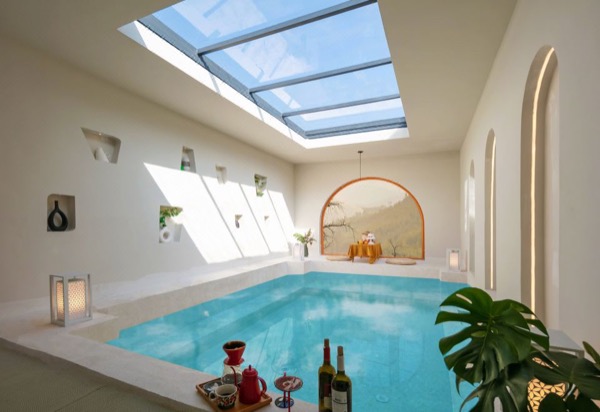
65 properties have a pool, but not one records an indoor pool — all are outdoors. From late October the pool drops from "usable" to "scenic"; do not let it be the selling point on a call, and do not filter on it.
What is genuinely scarce this season is a hot spring: 24 properties, of which 9 sleep 10–19, 10 sleep 20–29, 1 sleeps 30–39, and 4 sleep 40 or more. A group in the thirties has one or two options, not a shortlist.
Worse, conditions multiply rather than add. In the 20–29 band there are 42 properties: 33 explicitly allow events, adding a kitchen leaves 13, adding a meeting or multi-purpose room still leaves 13, adding barbecue facilities still 13, and adding a hot spring leaves 5. Ask for all four and the pool falls to one eighth.
7. Supply by headcount: 30 to 39 is the hardest band
Capacity across the 100: 39 sleep 10–19, 42 sleep 20–29, 7 sleep 30–39, and 12 sleep 40 or more. Houses are built to either a 20-person or a 40-person specification, and the middle band is empty — you did not fail to find it; it was never built.
Above 30 people a Shanghai group has one more thing to check: the coach. All 100 offer free parking, but that field is car-shaped — not one record states how many bays there are or whether a coach can turn around. Village lanes are narrow; some courtyards cannot take a 35-seat vehicle at all, so people unload at the village entrance and walk in, which is especially grim in rain. Ask separately.
Three rules that work: at around 35 people, book from the 40-person band (12 properties against 1 — twelve times the choice); above 45, split into two houses in the same village, which is easier for room allocation and flow than one overloaded building; below 20, do not book a 40-person house "for headroom", because the price is per building and the spare capacity is pure sunk cost.
8. Six questions to turn into numbers before booking
Every judgement above reduces to six sentences on the phone. Whichever one goes unanswered is what fails on the day; get numbers for all six and the trip will not run away from you.
- "We arrive at 11:00 — can we drop bags and use the living room?" (99 release rooms at 14:00 or later; 95 store luggage.)
- "What is the latest reception time? We may arrive at 22:30." (Only 14 state a cut-off; 11 accept arrivals after 23:00.)
- "When do quiet hours start and end, and can that go in the booking notes?" (22:00 for 25, 23:00 for 18, 21:00 for 9; 7 record a daytime hour.)
- "After 12:00 check-out on Sunday, how long may we stay in the courtyard and living room?" (98 check out by 12:00; the most generous allows 13:00.)
- "Can a coach reach the door, how many bays, can it turn around?" (100% free parking, but bay counts are nowhere in the data.)
- "How many burners, how many place settings, and who supplies the charcoal?" (42 have kitchens, 86 have barbecue facilities.)