Choosing a Team Villa near Shanghai
What Shanghai calls a team villa is three different products: an hourly party house, a small weekend rental sold by the room, and a whole guesthouse in Moganshan. Settle the overnight question first, then check the size ladder.
1. The Shanghai villa and the Moganshan villa are not the same product
Search for a team villa around Shanghai and you get three unrelated things. Their pricing, their usable hours and their capacity have nothing in common, so comparing them on rate alone is meaningless.
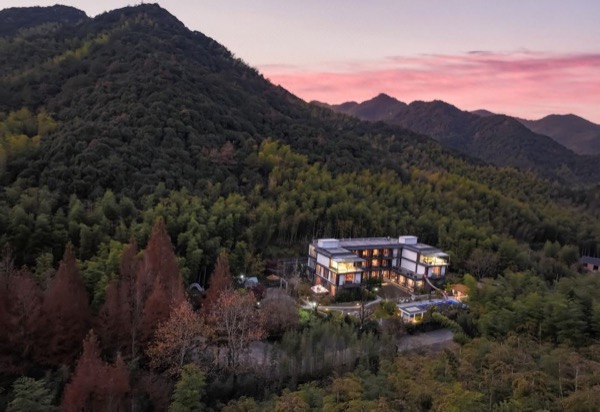
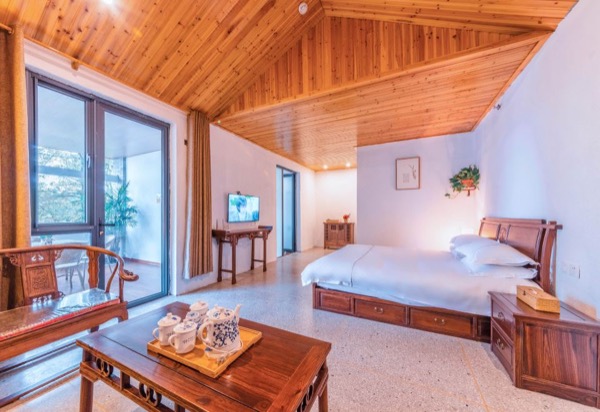
The Moganshan version is a whole guesthouse rented by the day: real bedrooms, sleeps 10 to 75, usually breakfast included and dinner available to order. You are not buying a better room, you are buying a building plus an evening.
- Hourly party houses (city and inner suburbs): billed by a four-to-eight-hour block, with KTV, pool table, mahjong and a kitchen, but very few beds. You are buying a loud afternoon.
- Weekend villas in Chongming, Qingpu or Songjiang: overnight is possible, but most sell by the room and hold six to twelve people, so a group of twenty ends up booking three or four buildings.
- Whole-guesthouse rentals in Moganshan: the building, the bedrooms and the meals, sold by the day, capacity 10 to 75.
2. First cut: does anyone actually sleep there
This single question eliminates one category. For a daytime-only event — a quarterly meeting, a team day before the annual party, a relaxed afternoon — the party house wins: thirty minutes away, billed by the block, no breakfast and no check-out to manage. The moment your plan includes an evening, the options collapse to the other two.
From Shanghai, the 100 properties in our data sit 156 to 177 km in a straight line, median 167 km, or 2.5 to 3 hours by road. That lands exactly in the zone where you can go but cannot come back the same day. One correction to a very common claim: the one-hour high-speed rail trip from Shanghai to Moganshan does not exist. That hour gets you to Deqing station; the town is another 15 to 20 km and 25 to 30 minutes, with a transfer at the end.
3. Second cut: is the building yours alone that day
All 100 properties are whole-unit rentals — 95 detached, 5 whole-floor — and none shares a building with another group. So in Moganshan, asking whether you can book the whole house filters out nobody. The three questions that do matter are whether the courtyard, pool and grill area are exclusive, whether the owner lives on site, and whether there is construction next door.
For groups above twenty this becomes decisive. The larger the group, the further the event spills from the living room into the courtyard, and a shared courtyard means you effectively have none.
4. Third cut: fitting the group and paying for it are two different problems
Capacity runs from 10 to 75 with a median of 20. By band: 42 properties sleep 20 to 29, seven sleep 30 to 39, twelve sleep 40 or more. That looks like plenty above thirty, but isolate the properties that fit a group exactly and the curve breaks: 35 people is the narrowest band in the entire dataset — one property fits 35 to 39, while eight fit 40 to 44.
This is not a data error, it is how the buildings were built. A house is either designed for twenty (ten-odd rooms) or for forty (twenty rooms), and 35 has no matching product. The practical strategy follows: at around 35 people, either book from the 40-person tier and accept a few empty beds in exchange for seven times the choice, or split into two buildings (20 plus 15), which also solves the rooming problem — colleague politics and bed allocation are best kept apart. The full distribution of exact fits:
- Fits 20–24 exactly: 31 properties
- Fits 25–29 exactly: 11 properties
- Fits 30–34 exactly: 6 properties
- Fits 35–39 exactly: 1 property
- Fits 40–44 exactly: 8 properties
5. To be honest: four cases where you should not come
Everything above is the case for Moganshan. This section is the case against it. In these four situations the trip is not merely a compromise, it is structurally wrong, and the team will remind you of it afterwards.
- Under 15 people: the base cost of a whole building spread over a dozen people costs more per head than a city hotel, and you never use the several hundred square metres of living room and courtyard.
- Half-day programme only: five to six hours of driving for four hours of activity is negative value, and you still drive home in the dark.
- Anyone in the group cannot handle a long ride: 2.5 to 3 hours each way with a final stretch of mountain switchbacks will rule out the carsick, the pregnant, the bad back and the parents of toddlers.
- The only goal is dinner and karaoke, or the budget covers little more than a city dinner and a private room: do both in the city, cheaper, simpler, with no parking or check-out to coordinate.
6. When it is genuinely the best option
Flip the conditions and the answer is obvious: 20 to 40 people, a two-day one-night trip, a requirement that everyone sleeps under one roof, and a programme with cooking, grilling, an awards session or a long late conversation — anything that needs everyone present and no outsiders walking through. In our data 84 properties explicitly allow events, 86 can host a barbecue and 42 have a kitchen. Note that "can host an event" and "can cook for twenty" are two separate sets of facilities.
One hard boundary has to be priced into the schedule first: 81 properties release rooms only after 14:00 and 90 require check-out before 12:00. A "one-night stay" is really Saturday 14:00 to Sunday 12:00, twenty-two hours. A Shanghai group reaches the foot of the mountain by 11:00, so those three hours are time with somewhere to stand but no room to use. Put cooking, awards or anything indoor before 14:00 and the plan stalls on site.
7. Coming in late October? Strike the pool from your checklist
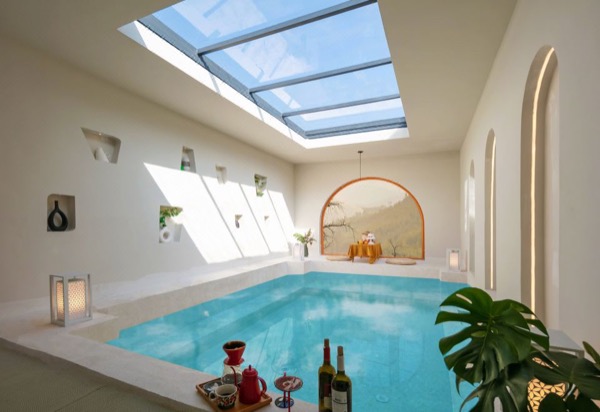
This is the most valuable point in the article. Sixty-five properties have a pool, but across all 100 the tag "indoor pool" appears zero times, while "outdoor pool" appears 57 times. These pools are outdoors. Once the water temperature drops at the end of October, a pool stops being a feature and becomes scenery.
What is genuinely scarce in this season is hot spring water: 24 properties have it, 21 of them also with a pool. By capacity, nine sleep 10 to 19, ten sleep 20 to 29, only one sleeps 30 to 39, and four sleep 40 or more. A group of around twenty still has ten options for a whole house with a soak; at thirty, there is one.
So the autumn priority order is hot spring and indoor space ahead of the pool. A group that makes the pool the first condition pays for a facility it cannot use that day.
8. Six questions to settle before you call
Villas cost more decision effort than hotels because everything must be fixed before payment. These six are ordered by consequence and can be read aloud.
- Is the building exclusively ours that day, and are the courtyard, pool and grill shared with anyone?
- How many bedrooms, how many twin rooms, and how would you room our group? (72 properties allow extra beds, 28 do not.)
- Can we drop luggage before 14:00, and how long may we stay after check-out? (95 store luggage, but 90 hold the 12:00 check-out.)
- Is the kitchen usable, how many burners, is there a stock pot and enough plates for twenty? (42 have kitchens.)
- Is the hot spring or soaking tub open in this season, and during which hours? (24 have one; hours vary.)
- Can you issue a company fapiao, what is the deposit, and is it refunded on the day of check-out?