Is Moganshan Worth the Drive from Nanjing?
Nanjing to Moganshan is about 190 km and 2h45m each way. This is not a pitch either way: work out the 22 hours you actually get in the house, the commute ratio against Hangzhou, five cases where the drive is the wrong call, and a verdict for each group size.
1. Three tiers of options, split by drive time
A corporate team day out of Nanjing is not really a question of where to go. It is a question of how far to drive. Split the options into three tiers by drive time and the products turn out to be completely different.
Tier one, the one-hour ring: Tangshan, Jiangning, Guli and the Niushoushan side. Same-day return, no leave needed, a choice of standard hotel and resort meeting rooms. Cheap, predictable, low friction. The downside is that nobody remembers it; in practice it feels like the same meeting room in a different postcode.
Tier two, the two-hour ring: Yangzhou, Zhenjiang, the Tianmu Lake area and Yixing. Hot springs, lakes, mature resorts and plenty of suppliers who will sell you a packaged programme. But it is still priced per head and per activity: the restaurant is shared, the lawn is shared, and the public areas close around ten at night.
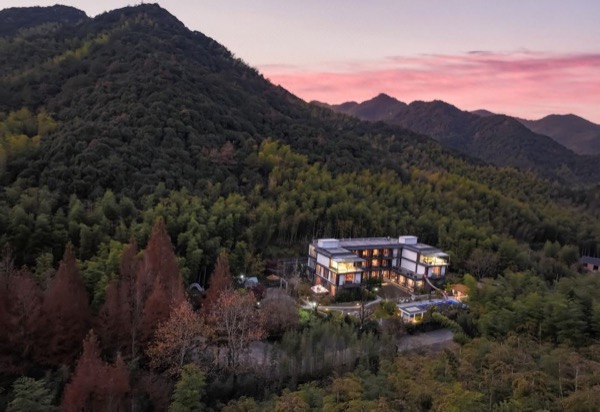
Tier three, three hours or more: Moganshan and Anji. This is the only tier that sells you a whole house for 22 hours. So the real question is not whether Moganshan is nice. It is whether tiers one and two can deliver the thing you actually need.
- Tier one (1 hour): a room plus a meeting room, same-day return, no accommodation cost.
- Tier two (2 hours): activities plus a package, priced per head, no exclusive use of shared space.
- Tier three (3 hours or more): one house for 22 hours, priced per building, exclusive but with a higher bar to clear.
- Moganshan sits in tier three. The premium is not the scenery. It is the length of time the place is yours alone.
2. Five cases where you should not make the drive
Start with when not to come. This is not politeness. Moganshan is not the default answer for a Nanjing team, and the teams that treat it as the default are the ones that come back saying it was not worth it.
If any one of the five applies, keep the budget in the Nanjing suburbs. If none applies, keep reading.
- Fewer than 15 people. Six hours of driving spread across 14 heads is roughly 26 minutes per person, spent to buy one dinner and one karaoke session, both of which exist inside the 40-minute ring around Nanjing.
- Half a day or a single day, with no overnight stay. What Moganshan sells is a house for 22 hours. Skip the night and you have spent six hours of driving on lunch.
- The programme is dinner, singing and cards. None of those needs a 190 km drive, and a suburban resort does them cheaper.
- Several people cannot sit for long stretches: late pregnancy, post-operative recovery, severe car sickness, or children under three. The one-way drive starts at 2 hours 45 minutes and service areas are not dense.
- The date falls between December and February and the group is not willing to drive mountain roads after dark. Sunset in northern Zhejiang is around 17:00 in November and earlier in the hills.
3. The arithmetic: 22 hours is the same for every origin city
This is the number worth remembering. Across the 100 listings on this site, 99 require check-in at 14:00 or later and 98 require check-out by 12:00. Whatever city you drive from, the house is yours for 22 hours. Not one minute more.
Divide round-trip driving time by those 22 hours and you get a commuting ratio. Hangzhou, about 3 hours round trip, scores 0.14. Suzhou, 4 hours, 0.18. Ningbo, 5 hours, 0.23. Shanghai, about 5.5 hours, 0.25. Nanjing, 6 to 6.5 hours, scores 0.30. A Hangzhou team pays 8 minutes of driving per hour in the house. A Nanjing team pays 18.
That gives the question a hard answer: the 3.5 extra hours a Nanjing team spends buy no extra time on site at all, only a different location. So the thing to judge is not whether Moganshan is good. It is how much of those 22 hours can only happen in this particular stretch of hills.
- You need exclusive use of a whole building, and to carry on late without worrying about the neighbours. Only a whole-house booking provides that.
- You need more than 20 people under one roof. A hotel splits them across a dozen twin rooms.
- You need the following morning: dawn in the hills, breakfast on the terrace. A day trip never gets it.
- You need unscheduled time. A resort runs to a timetable; a whole-house booking leaves gaps.
- Score zero out of four and the drive is not worth it. Score two or more and those 3.5 hours pay for themselves.
4. What the extra hours actually buy
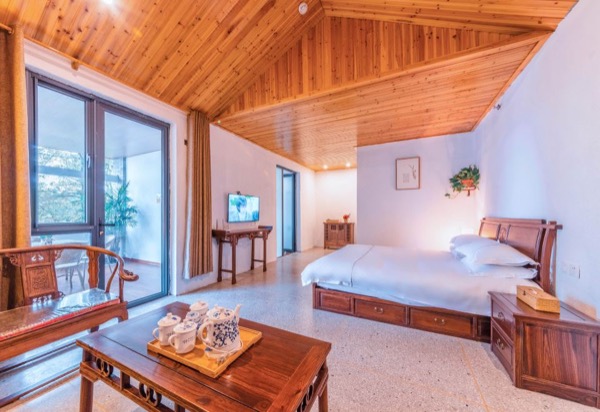
Broken down, the premium buys three things the first two tiers cannot deliver. First, the whole building is yours: 95 of the 100 listings are entire houses, 5 are entire floors, and there are no strangers in a shared lobby. Second, the night does not close: 8 of the 22 hours fall in a part of the evening that hotel-based team building simply does not have. Third, the 8:00 to 12:00 window on the second morning, which day trippers never see.
The boundary matters though. An open night is not an all-night party. 84 listings state that events are allowed, but quiet-hours rules are a separate field: 38 list nothing at all, which means negotiating on arrival, 25 start at 22:00, 18 at 23:00 and 9 at 21:00. Ask on the phone what interval the quiet hours cover. Do not assume that allowed events means an all-nighter.
One more pass at the clock: check in at 14:00 on Saturday, dinner at 18:00, indoor session at 20:00, breakfast at 8:00, check-out at 12:00. Only 5 to 6 hours carry any content. The rest is sleep, meals and driving. A Nanjing team is buying the quality of those 5 or 6 hours, not the size of the building.
5. A Nanjing group cannot reschedule, so filter with four conditions multiplied
A 3.5 hour drive has a side effect. If the place turns out to be wrong there is no turning back, and rain does not cancel it. So a Nanjing group has to book somewhere that still works indoors.
Multiply the conditions and the number falls fast. 61 listings sleep 20 or more. Of those, 48 state that events are allowed. Add a meeting or multi-purpose room and it is 43. Add a games room or karaoke and only 40 remain: 26 in the 20 to 29 band, 6 in the 30 to 39 band, 8 above 40 people.
In other words, you think you are choosing among 61 and you are really choosing among 40. Past 30 people, it is 6. That is why a Nanjing group books a month ahead. Not because peak season is tight, but because the pool of listings that qualify is small to begin with.
- "When it rains, how many people can sit indoors at once?" The question is about capacity, not about whether the room exists.
- "Is the games room and karaoke ours alone, or do we queue with other guests?"
- "How large is the meeting space and how many does it seat?" 87 listings have one, but whiteboards, projectors and microphones appear zero times across the whole database, so do not assume they are there.
- "Events are listed as allowed. Until what time?" That is a separate field from allowed events. Ask both.
6. In autumn and winter the scarce feature is the hot spring, not the pool
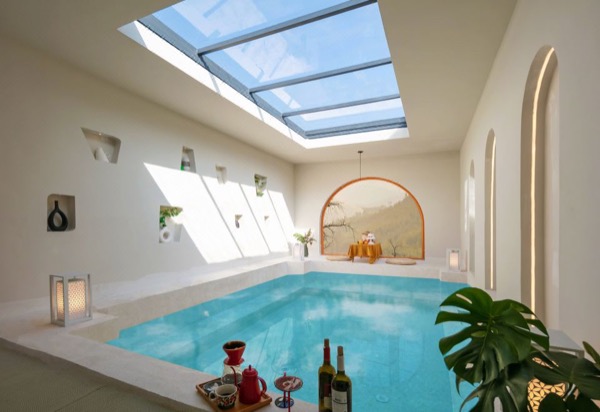
65 listings have a pool, which looks like a standard feature, but indoor pools appear zero times across the whole database. All 65 are open air. After November a pool is a view and nothing more, and a Nanjing group paying extra for one is wasting the money.
The scarce thing is the hot spring: 24 listings, of which only 15 sleep 20 or more, with 10 in the 20 to 29 band, just 1 in the 30 to 39 band and 4 above 40. Add events allowed, meeting space and a games room or karaoke and only 13 remain site-wide.
Heating needs thinking about even earlier. Heating as a facility field returns zero results site-wide, and underfloor heating appears in the room names of just 7 listings. Heating is not a filter you can apply here. Read the room names one by one, or ask directly on the phone.
7. Sunday return: be on the road by 13:00
98 listings require check-out by 12:00 and 95 offer luggage storage, so bags are not the problem. Time is. The return drive is 229 to 277 km, 2 hours 45 minutes to 3 hours 15 minutes, and the last stretch runs on Provincial Road 304 and county mountain roads, with tunnels and an 80 km/h limit.
Run the numbers: check out at 12:00, allow 1.5 hours for lunch, leave at 13:30, and you are back in Nanjing between 16:15 and 16:45, in daylight the whole way. Decide to squeeze in one more activity and leave at 16:00 instead, and the final stretch is a night drive: tunnels, hairpins and oncoming full beam. That road is not worth gambling on.
The conclusion is blunt: do not schedule anything for Sunday afternoon that runs past check-out. Put every activity between Saturday afternoon and Saturday night. Sunday gets one lunch.
- Pack on Saturday night and do not go back to the rooms on Sunday. The 20 minutes saved is the lunch break.
- At check-out, confirm what time the stored luggage must be collected. Do not assume dusk.
- Book lunch on the way out of the hills rather than deeper into them, then drive straight on.
- Roster the drivers. On a 3 hour drive, swap at least once.
8. Verdict by group size, plus six questions for the booking call
The same drive from Nanjing produces a completely different answer depending on headcount. This is the last table.
Six closing questions, covering the six gaps that genuinely exist in this dataset. None of them is small talk:
- Under 15 people: not worth it. Stay in the suburbs.
- 15 to 19: borderline. Go only if exclusive use of a whole house plus an overnight stay is the actual requirement. 39 listings sit in this band.
- 20 to 29: the band where it pays off. 42 candidates, 26 of them clearing all four conditions, and 6.5 hours of driving spread across 25 people is 16 minutes each.
- 30 to 39: candidates collapse to 7, and only 6 clear all four conditions. Book at least a month ahead.
- Over 40: 12 listings, 8 clearing all four conditions, which is a wider field than the 30 to 39 band. Search in the 40-person band directly.
- "Is the whole building ours alone, or will there be other guests?"
- "From what time must there be no noise? I am asking for the interval, not the start."
- "When it rains, how many people can sit indoors at once?"
- "Events are listed as allowed. So until what time can they run?"
- "Is the hot spring a private tub or a shared pool, and is it open in winter?"
- "After the 12:00 check-out on Sunday, what time must the stored luggage be collected by?"