Is a Rented Villa Actually Better Than a Hotel?
A whole-villa rental wins on exclusive space, self-paced scheduling and cooking together. It loses on service, bed configuration and meeting hardware. All numbers come from 100 verified Moganshan properties.
1. Start by admitting most team trips do not need a villa
This is not an argument about atmosphere. The difference between a hotel and a rented villa is not quality — it is whether you are renting a few rooms or an entire building. Rent rooms and you share the lobby, the restaurant and the parking with the company next door. Rent a building and it belongs to your group alone for the day.
That rules out half of all cases immediately. Under ten people, a half-day programme, an agenda that is mostly meetings and meals — a city hotel is cheaper and simpler: nobody drives, nobody has to organise cooking, and the room is staffed on schedule. The reverse also holds: if your programme contains one moment where everyone must be in the same place and no outsider may walk in, a whole-villa rental is close to the only option.
- Meetings plus one night: hotel. Meeting room, projector and coffee breaks are already there.
- Around 20 people, mostly eating, drinking and talking: villa. Cheaper per head, and a completely different atmosphere.
- A ceremony, a loud evening, a late finish: villa — but confirm the quiet-hours clause first (section 6).
- More than 50 people: only 2 of our 100 properties sleep over 50. Do not force it.
2. Advantage one: you are buying the only venue, not a better room
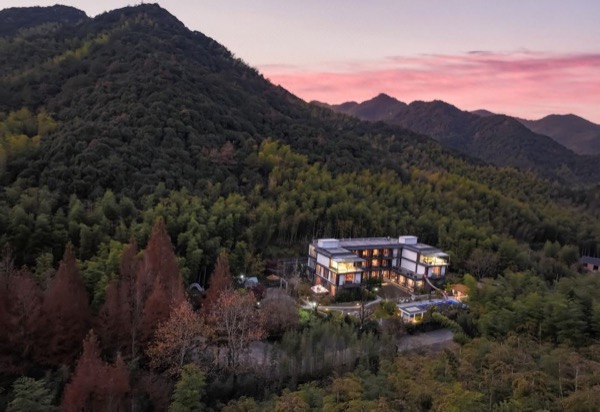
Every one of the 100 properties we track is a whole-unit rental — 95 detached houses, 5 whole floors. Not one is a set of rooms inside a shared building. That single fact sets the floor on what your trip can be: no rival group next door, no lobby taken over by someone else, no reminder at ten in the evening that other guests are sleeping.
The buildings are also far larger than hotel inventory. Median built area is 790 sqm, with the largest at 5,000 sqm; capacity runs from 10 to 75, median 20. Twenty people sharing 790 sqm works out at roughly 40 sqm each. A hotel gives those same 20 people ten standard rooms of 25–30 sqm for two — 13 to 15 sqm per person — plus a public area they compete for with strangers.
The test is simple: does your programme contain a moment where the whole group is in one room? If yes, rent the building. If no, hotel room types are more uniform and nobody has to share a bed with a colleague.
3. Advantage two: the schedule runs on your clock, not the banquet slot
Hotel function rooms are sold in blocks: two hours at a time, audio billed separately, overtime surcharged, and out by 22:00 in most cases. A villa is sold by the day. From key handover to check-out the building is yours, and you decide when dinner starts, when the awards happen and when people go to bed.
That "by the day" has a boundary, and this is where budgets go wrong. In our data 81 properties hand over rooms only after 14:00, and 90 require check-out by 12:00. A one-night stay therefore gives you Saturday 14:00 to Sunday 12:00 — 22 hours — minus sleep, two main meals and packing. Saturday morning is time when you have somewhere to be but no house yet. Do not schedule indoor sessions into it.
So the villa wins on the slow parts — cooking, a long conversation in the courtyard, stars. The hotel wins on the punctual parts — agenda, hosting, projection, registration. Count which kind your programme has more of and the answer follows.
4. Advantage three: cooking together is the one activity that needs no facilitator
Team building is usually hostage to a facilitator and a box of props. A rented villa offers a plainer mechanism: make twenty people produce one meal. Washing, chopping, watching the fire, plating — you will see within an hour who takes charge, who disappears and who quietly fills the gap. Nobody feels it was arranged for them.
The catch is physical, and it is in the data: only 42 of 100 properties have a kitchen; 58 do not. Those without usually offer a grill (86 can barbecue) or ordered-in meals (91 list a restaurant, 46 offer room service). "Eating together" is the same phrase for three completely different cost structures and levels of participation.
For twenty people, the realistic minimum is two hob burners, one grill and standing room for four cooks at once. Many "kitchen" listings are a small prep counter: fine for boiling water, hopeless for ten dishes. Ask on the phone, never trust the tag.
- How many burners, and is it gas? An induction hob will not move a large pan.
- Is there a stock pot, a steamer, a rice cooker? Twenty people means three rounds in a domestic cooker.
- How large is the fridge — does it hold two days of food for twenty?
- Are there twenty sets of plates and cutlery, or only disposables?
- Who washes up, and is there a dishwasher? This one decides the mood of the evening.
- Charcoal or gas grill; who buys the charcoal; does the village require notice?
5. Where the villa loses: three things hotels do better
First, the service is one caretaker, not a department. Only 17 of 100 properties list an iron or garment steamer, only 3 run a shuttle, and none has a front desk. An iron, a car, a plaster at short notice means phoning someone, not walking to a lobby.
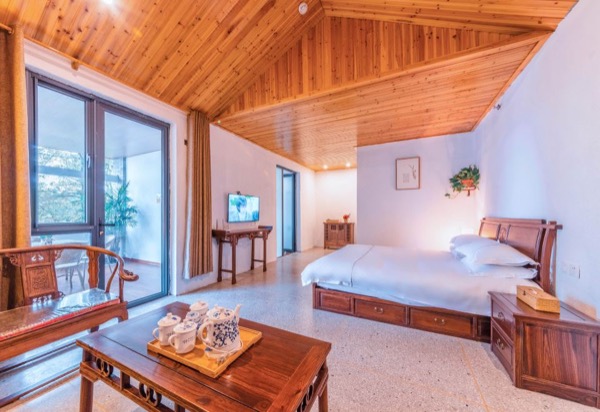
Second, bed configuration does not always fit working relationships. Of 895 rooms across the portfolio, only 127 are explicitly twin-bedded; only 66 properties have at least one twin room, and the rest are dominated by doubles. A hotel room is twin by default, a villa room is double by default. Splitting the group "two to a room" will fail here — twenty people typically need nine or ten rooms, and few of them take two colleagues comfortably.
Third, meeting hardware means "a room exists", not "a meeting can run". 87 properties have meeting space: 73 a meeting room, 63 a multipurpose room, 62 an AV presentation system, 77 a PA system. Our data stops at the equipment level — not one property records whiteboard markers, HDMI cables or adapters. 62 properties with a presentation system only means there is a projector or a screen, not that your laptop will connect. Bring the machine, the adapters and a 3-metre HDMI cable.
6. The overlooked fact: events allowed does not mean events until late
84 properties explicitly permit events. Cross that against kitchens and 50 of them have no kitchen. The "events allowed" label quietly hides the fact that feeding twenty people is now your problem. A hotel gives you no kitchen but does give you a restaurant; a villa gives you freedom but not capacity.
Now the quiet hours. Among those 84: 24 have no clause at all, 25 fall silent at 22:00, 17 at 23:00, 9 at 21:00 (site-wide the split is 25 / 18 / 9 / 38 with no clause). Which means events allowed plus a 21:00 curfew leaves you one evening. If the party, the barbecue and the awards all sit after dinner, do the arithmetic before you promise anything.
This is the counter-intuitive part of villa team building: the freedom has edges. The benefit is not that you can do anything — it is that everything can be fixed a day in advance. Fixed in advance, nothing surprises you on site. Left open, the whole evening runs on luck.
7. When to book a hotel instead
Four situations where a rented villa is the wrong tool, and forcing it looks bad.
- Over 50 people: only 2 properties sleep more than 50, 10 handle 40–49, and the 30–39 band has just 7. Supply is a staircase, not a slope.
- External clients or senior management attending, where formality matters: the lobby, the meeting room, the name cards and the staff are things a villa cannot supply.
- Professional conferencing: simultaneous interpretation, LED walls, badge systems, breakout rooms — standard hotel products.
- One night only, arriving after 22:00: 81 properties release rooms after 14:00, so a late arrival means paying for a night you barely use.
8. The booking call: eight questions that decide the trip
A villa costs more decision effort than a hotel because everything has to be settled before you pay. These eight questions are ordered by consequence and can be read out loud.
One last note: do not ask whether they can host a team, ask what the largest group they have served was, and what went wrong. The first question always returns a yes. The second is the one that gets a real answer.
- Is the building exclusively ours that day — no other group, no owner living on site? (95 are detached; rule out shared courtyards.)
- Is the kitchen usable, how many burners, is there a stock pot and enough plates for twenty? (42 have kitchens.)
- When do quiet hours start, and how late can the grill and the sound system run? (22:00 for 25, 23:00 for 18, 21:00 for 9.)
- How many twin rooms are there, how would you room twenty people, can beds be added? (127 of 895 rooms are twin; 72 properties allow extra beds.)
- How many cars fit in the courtyard, and can a coach reach the door? (Parking is free at all 100, but capacity varies widely.)
- Can you issue a company fapiao, what is the deposit, and is it refunded on the day of check-out?
- Can we drop luggage before 14:00, and how long can we stay after check-out? (95 store luggage.)
- Where is the nearest market, and will you receive groceries we ship ahead?