How to Plan a Family Trip with Three Generations
Beds, a kitchen and quiet hours decide a family trip far more than sightseeing does. What 100 verified whole-villa rentals in Moganshan actually offer, and what to ask before paying.
1. Page one is not the sightseeing list. It is who sleeps when
Most family itineraries start with where to go. What actually ruins the trip is three things unrelated to any attraction: grandparents turn in early, children still need a nap, and the younger adults want to sit up. Put those three rhythms in one house and the points of conflict are predictable — enough beds to split, a kitchen you can cook in, and noise that reaches someone trying to sleep.
All 100 properties here are whole-unit rentals (95 detached villas, 5 whole floors) with a median floor area of 800 m². Space is rarely the problem. Friction comes from those three things, and all three can be settled before you pay.
2. Count beds, not people: only 192 of 895 rooms have two single beds
Group people by how they sleep, not by how many there are. Across 895 rooms there are 765 single beds, but only 192 rooms put two single beds in one room — 21% — spread over 76 properties. That leaves 24 properties with no such room at all, and 18 with not a single single bed anywhere in the house.
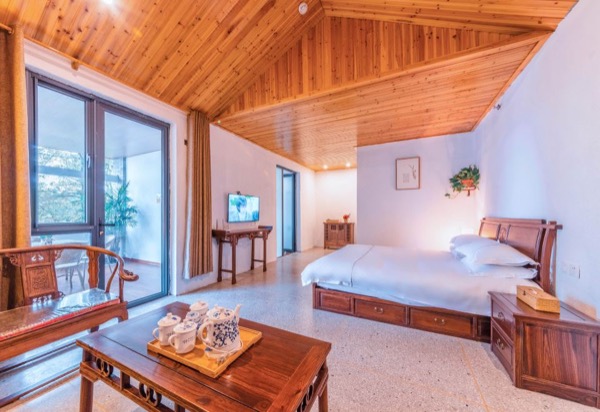
Teams can be rough about this: two colleagues sharing a king bed will survive. Families cannot. Grandparents usually will not share, two children need separate beds, and the parents' room still has to fit a cot. All three are hard requirements, and a king-bed room answers none of them.
- Count the people who need a bed of their own — grandparents, children old enough to sleep alone. That number is how many twin rooms you need.
- A typical three-generation group of six: one twin for the grandparents, one king for the couple with the youngest, one twin for the two children.
- 154 of 895 rooms carry "family", "parent-child" or "kids" in the room name, but that only signals size. A room called family-friendly and a room with two beds are different things.
- 72 properties allow an extra bed, 28 do not. Where extra beds are not allowed, headcount must stay strictly under the cap; nobody will fix it on arrival.
3. The smallest house here sleeps 10, so small groups are harder to place
Capacity runs from 10 to 75 with a median of 20. The floor is 10: a family of six, or two families adding up to eight, will not find a house that "just fits". You rent a ten-person house and pay for ten.
The supply curve is counter-intuitive. The 10–19 band holds 39 properties, of which only 14 take 10–14 people, while 40+ holds 12. Small houses are not more plentiful than large ones — the scarce thing in family travel is a small house.
So the first decision is not where to go; it is how many families to combine. Two families of eight in a ten-person house, or three families of twelve to fourteen in a fifteen-to-nineteen-person house, spreads the cost over more people for practically the same experience — the whole property is yours either way.
4. With a child under three, you are bringing the equipment
There are ten child-facility tags in the data, and the best covered are slippers (58 properties), toys (55), child toothbrushes (48) and board games (47). Search the whole dataset, though, and "cot" appears zero times, "microwave" zero, "washing machine" and "dryer" zero.
That does not mean none of the 100 have them. It means appliance-level fittings are simply not reported in the OTA tag system: absent from the page does not mean absent from the house, and present on the page does not mean adequate. The only workable conclusion: every piece of infant hardware must be confirmed by phone, never inferred from a listing.
Even the secondary items are thin: strollers on 4 properties, childcare on 17, child bathrobes on 15, kids' clubs on 8. With a child under one, pack as if for an upgraded campsite — cot, weaning kit, baby bath. If you want to skip the bath, 49 properties list a bathtub in a room type, which beats a shower for washing a small child.
5. With children of four to nine, you need a garden, water, and other kids
What this age needs is simple: a garden to run in, and something involving water. Lawns and gardens appear on 91 properties, kids' entertainment on 87, playgrounds on 44, board games on 47, games rooms on 18 — but slides on only 6, a swing on 1, and trampolines and sandpits on zero. Do not be sold by the phrase "children's facilities"; usually it means a lawn and a box of toys.
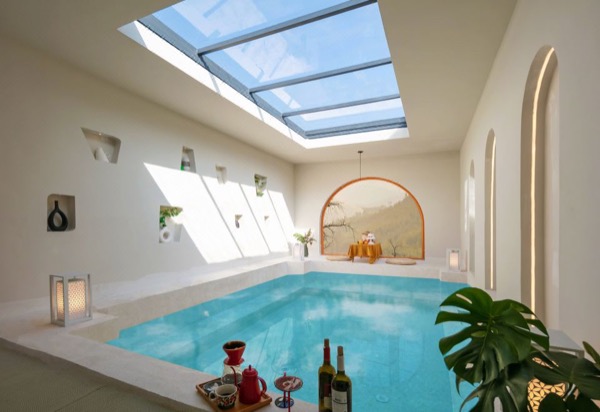
Water needs saying plainly: 65 properties have a pool, but zero have an indoor pool and zero have a children's pool, and 57 state an outdoor pool. Swimming with a child means watching them in a full-depth pool, entirely at the mercy of weather and season. After late October the water will not hold, and the pool drops from "somewhere to swim" to "a backdrop for photos".
The off-season substitute is a hot spring: 24 properties, 20 of which name a private in-room tub. Add 72 with a tea room and 91 with a lawn and an afternoon is covered. Compress the rule to one line: under nine, an itinerary needs a garden and one water activity, not attractions.
6. The kitchen is the dividing line: 42 have one, 58 do not
42 properties have a kitchen, 36 list a shared kitchen, 30 offer children's meals, 46 offer room service, and 86 have barbecue. Nobody will go hungry. The question was never whether there is food, but at what time you can eat it.
Children eat on their own schedule. They want dinner at 17:30; the adults want to start the barbecue at 19:00. In that gap a kitchen lets you boil noodles, reheat a meal, cut up fruit. Without one you wait for the restaurant or order in, and delivery radii in these mountains are far wider than in the city.
With a child under six, then, a kitchen is not a bonus but a filter. 42 against 58 cuts your shortlist in half before you compare beds and gardens.
7. Fitting three generations into 22 hours
81 properties state check-in from 14:00 and 90 state check-out before 12:00, so one night is roughly 22 usable hours, split into two blocks. The family difficulty is that lunch, nap, dinner and bedtime all have to happen inside the house.
A workable schedule: 14:00 arrive and unload, 14:30–17:00 is the only continuous stretch with everyone present (garden or pool), 17:00–19:00 cook and barbecue, 19:00–21:00 indoors with the children going down first. Day two: 07:00–10:00 breakfast and garden, 10:00–12:00 pack and check out.
Do not plan on going back to the room for the nap. At 13:00 the rooms are not released yet. Either let the child sleep in the car, or push arrival to 14:30 and go straight in.
One conclusion runs exactly opposite to team trips. Quiet hours start at 22:00 on 25 properties, 23:00 on 18, 21:00 on 9, midnight on 3, and are unset on 38. Team organisers complain that 21:00 is too early; families with small children should actively seek out those nine — what wakes a child is rarely your own group, it is the team in the next house still singing.
8. Eight questions to settle before the deposit
The information gap lives almost entirely on the phone. Family trips have far less margin than team trips: an adult can put up with one bad night, a child cannot. Ask these eight, then pay.
A family itinerary, on its last page, is really one bed chart and eight phone questions. The attraction can change at short notice; the beds cannot.
- "Is there a room with two single beds? How many?" (Only 192 rooms site-wide; 24 properties have none.)
- "Our youngest is X years old — can you provide a cot, and what model?" (Zero cot records in the data.)
- "How far can we use the kitchen? Is there a microwave for warming baby food?" (42 properties have a kitchen.)
- "Bathtub or shower only?" (49 room types list a bathtub.)
- "How deep is the pool? Is there a shallow area or a kids' pool?" (Zero children's pools site-wide.)
- "What time do quiet hours start? Is the house next door a team group or a family?" (9 start at 21:00; teams and families want opposite things.)
- "We arrive at 13:30 — can we use the garden first? When is the earliest the rooms are ready?" (81 state 14:00 or later.)
- "Can we check out at 13:00? The children sleep in." (90 state before 12:00.)