Travelling as Several Families: Share a Villa or Book Separately?
All 100 properties here rent by the whole building, so booking separately means booking different houses. Capacity tiers, bed types and measured driving distances decide which option actually works.
1. There is no room-by-room inventory, so the question is how many houses
The instinct when several families travel together is to book separately and keep things loose. That plan needs adjusting here: the 100 verified properties come in exactly two shapes — 95 entire villas and 5 entire floors. Not one rents by the room.
So booking separately does not mean three rooms in one building. It means three different houses. The decision therefore becomes a choice of three structures, and the difference between them is not price but how many times a day you have to gather.
- One shared villa: one living room, one kitchen, one courtyard for everybody. Least freedom, zero gathering cost.
- Two or three houses side by side: each family has its own door and yard, but you accept the running back and forth over where dinner and the children are.
- Completely separate: different villages, or Wukang, the county seat 11 km away with the full range of shops and clinics — median 11.4 km from the properties.
2. Check your capacity tier: only 14 houses hold 12 people exactly
Capacity runs from 10 to 75, median 20. Broken into bands: 10 to 14 people, 14 houses; 15 to 19, 25; 20 to 24, 31; 25 to 29, 11; 30 to 34, 6; 35 to 39, exactly 1; 40 and above, 12.
Three families with one child each usually land at 9 to 12 people, which is the thinnest band in the dataset. Four families at 12 to 16 can round up into the 15 to 19 band, where the choice immediately grows from 14 houses to 39. Inviting one more family is not about atmosphere; it buys back your options.
Two families at 8 people, by contrast, still pay for a 10-person house. Ten is the smallest unit that exists here.
3. Sharing a villa saves floor area and costs you an accountable person
The obvious gain is spreading the area. Every property is whole-building, so a house for around 20 people typically gives one living room, one dining room and a courtyard, and that space is not priced per head.
But one house has one kitchen, one bin and one bill. On a company trip an administrator absorbs this. On a family trip nobody does, so shopping, cooking, washing up, rubbish and the final settlement all get assigned on the spot. What usually goes wrong is not crowding — it is one family working from start to finish while another rests from start to finish.
- How the money works. Per head or per family? Do children count as half? Who fronts the cost? Settle it before departure, not after.
- How meals work. 42 properties have a kitchen, 36 a shared one, and 58 have none — those 58 mean eating out (91 have a restaurant) or ordering in (46 offer delivery).
- Who decides. Name one owner with the final call. Three families, three opinions, and nobody satisfied.
4. Sleeping arrangements break a shared villa on the first night
The classic scene: three families, six rooms, two mothers sleeping with their children, and two fathers looking at each other. Nobody is being difficult; the bed types simply do not match the group.
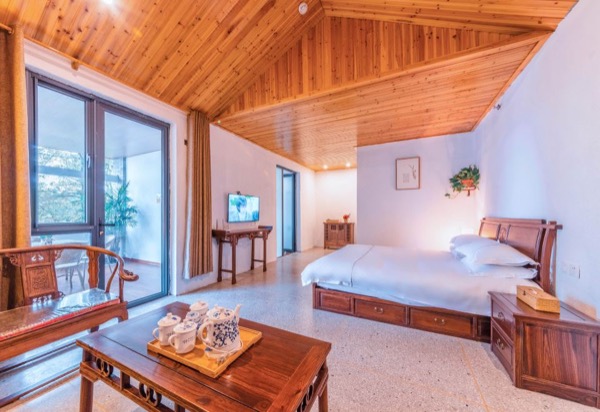
Across 895 rooms, only 192 (21%) put two single beds in one room, spread over 76 properties. Twenty-four properties have no such room at all. Extra beds are available at 72 and unavailable at 28.
Write the sleeping plan before you book: couples in a king room, the family with a small child in a room with an extra bed, single adults or two men sharing a twin. If demand for twin rooms exceeds what the house offers, the group does not fit — this matters more than twenty photographs.
5. The real bill for separate houses is kilometres
Measured between every pair of the 100 properties: median straight-line distance 5.75 km, with only 41.5% of pairs inside 5 km. Pick three houses at random and the two furthest apart sit a median 8.2 km away; one case in ten exceeds 16 km, and the maximum is 27 km.
There is no flat road here, so multiply that distance by time: the mountain section averages about 30 km/h, making 8 km a 20-minute drive. Families in separate houses spend at least one 20 to 30 minute leg per day just assembling, and the round trip costs a mealtime. With children add car seats, nap windows and loading in the rain.
Separate houses therefore suit one situation only: the trip happens outside the house — a full day at the scenic area or an outdoor base, with the house used for sleeping. If the point of the trip is being together, separate houses spend the most valuable thing you have on the road.
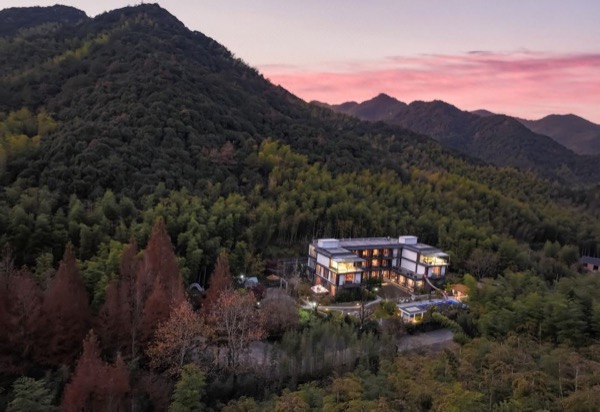
One caution: properties look tightly clustered (median nearest neighbour just 0.26 km, with 54 having another within 300 m), but that means the area is dense, not that the two you chose are next door.
6. With children, quiet hours are a filter rather than a drawback
Site-wide quiet hours start at 22:00 on 25 properties, 23:00 on 18, 21:00 on 9 and 00:00 on 3; 38 state none, and 7 record a daytime hour instead.
Company groups find 21:00 early. Families should want the opposite: what wakes a child is rarely your own group, it is the team-building house next door still singing. Those 9 properties are the priority list, and all 9 also allow events, so you do not have to choose between a place to play and a place to sleep.
If your own group intends to sit in the courtyard until eleven, exclude those 9 deliberately. A second hidden filter is an indoor room with a door that closes: 87 properties have meeting space, which lets children nap while adults talk.
7. Twenty-two hours does not fit two dinners, so the first meal is dinner
81 properties state check-in after 14:00; another 18 give a window starting at 14:00 or require 15:00, so 99 hand over the room at 14:00 or later. Checkout is before 12:00 on 98. One night is roughly 22 usable hours.
That fixes the schedule: the first meal is dinner, not lunch. Families arriving at midday eat on the road or at the foot of the mountain; the block that needs preparing is 17:00 to 19:00.
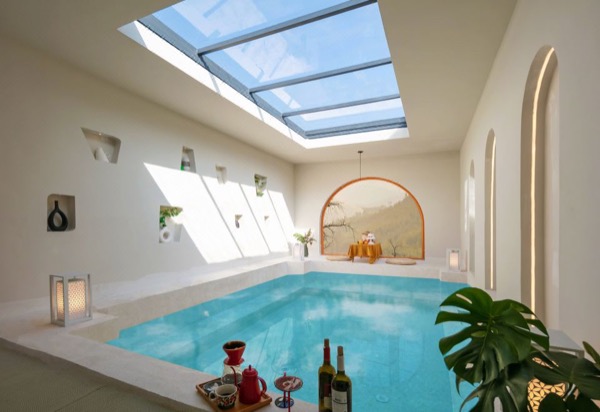
A schedule that works for four families and 15 people: arrive 14:00 and unload, 14:30 to 17:00 in the courtyard or pool — the only continuous stretch with everyone present — cook at 17:00, indoors from 19:00 to 21:00, children down first. Day two: breakfast 07:30, courtyard 09:00 to 11:00, bags from 11:20, room check at 12:00. Do not plan on a nap in the room at 13:00, because the room is not yours yet; sleep in the car or push arrival to 14:30.
8. Pass one test, then ask six questions
Sharing a villa saves money, time and driving, but it does not save compromise. A shared living room, cooking in rotation, keeping voices down after ten — if any one of these genuinely troubles one family, the trip becomes three days of that family accommodating everybody else.
So apply the test first: if one of the families cannot accept a shared living room, cooking in rotation and quiet after ten, do not share a villa — separate bookings are the better answer, provided the trip happens outside the house and the extra kilometres are worth paying for.
Once that passes, the remaining asymmetry lives on the phone. Ask these six before paying a deposit.
- "We are X families, Y people, Z of them children — how would you allocate the rooms, and is any room two single beds?"
- "Can we use the courtyard before 14:00? When is the room actually ready?"
- "What hours do quiet hours run?" — insist on a range; some listings record a daytime hour as a single point.
- "How far can we use the kitchen — pans, plates, seasoning included? Does the barbecue include charcoal and food?" 42 have a kitchen and 86 have barbecue facilities, and the difference is large.
- "If one more family joins, can you add a bed?" Available at 72 properties, not at 28.
- "Are there neighbours nearby?" This one decides whether you can talk in the courtyard at night.