Planning a Two-Day Team Trip from Across Jiangsu, Zhejiang and Shanghai
Planning a two-day team trip from several cities at once is rarely about picking the right mountain. It is about getting five cities to the same door. Real check-in, capacity and quiet-hour data from 100 verified whole-villa rentals, plus the six cases where you should not combine cities at all.
1. The real difficulty is five departure tables stacked on one house
"Jiangsu, Zhejiang and Shanghai" is one phrase in a search box, but in execution it is five cities, five departure times and five drive lengths. Mixed-origin groups rarely fail because the house was wrong. They fail because people do not arrive together — the Hangzhou group is there at 9:30, the Nanjing group is still on the mountain road at 11:30, and the early arrivals stand at the gate feeling awkward.
Start with the geometry, computed from the coordinates of all 100 properties: Hangzhou about 44 km (29–55), 1–1.5 h; Suzhou about 103 km (98–113), about 2 h; Shanghai about 168 km (156–177), 2.5–3 h; Ningbo about 179 km (161–188), about 2.5 h; Nanjing about 193 km (182–209), 3–3.5 h. The nearest and farthest properties are 149 km apart, which is two hours on the road.
Two hours is not a rounding error on a two-day trip. A property here gives you only 22 usable hours for one night, as the next section shows — two hours is a ninth of the total.
2. The 14:00 gate: arriving early gets you nothing
Everything else follows from this, and it is the most commonly missed fact: early arrival does not mean early access. At 99 of 100 properties, rooms are released at 14:00 or later — 81 state "after 14:00", 13 give a window starting at 14:00, and 5 do not open until 15:00. Exactly one property allows check-in after 09:00.
Check-out is tighter still: 98 require departure before 12:00, the earliest at 07:30, and the most generous stretches only to 13:00. Between the two, a one-night stay yields 22 usable hours, and that boundary is not negotiable.
So arriving early is not an advantage here. Someone standing at the gate at 10:00 and someone arriving at 14:00 enter their rooms at the same moment. Those four early hours have only two uses: go into the scenic area (which needs a shuttle connection and enough people to bother), or sit in the garden and wait.
3. The drive-time gap does not vanish — it becomes waiting, or an earlier alarm
This is the sentence to remember: the gap between cities is physical. It will not disappear; it gets converted into either waiting time or wake-up time. A mixed-origin group has exactly two models.
Model A — same departure time. Everyone leaves at 08:00: Hangzhou arrives 9:30, Suzhou 10:00, Shanghai 10:45, Nanjing 11:30. The waits are 4.5, 4, 3.25 and 2.5 hours. Those two hours of city difference are fully preserved, just converted into standing in the courtyard. In this model the closest group loses the most, because its drive-time advantage is worth nothing in front of a closed gate.
Model B — same arrival time. Everyone reaches the door at 14:00 and works backwards from their own drive time. The waiting goes to zero; the cost is that the farthest group leaves 90 minutes earlier. On a two-day trip that 90 minutes is bought with sleep, and what it buys is a synchronised afternoon for everyone.
- Hangzhou: depart 12:15–12:45 (1–1.5 h). The last group to leave; the final stretch is mountain road.
- Suzhou: depart 11:50 (about 2 h).
- Ningbo: depart 11:15 (about 2.5 h). It runs the Hangzhou-Ningbo expressway first and then turns onto the Nanjing-Hangzhou line, so do not budget 11:45.
- Shanghai: depart 11:00–11:20 (2.5–3 h). The urban exit is the likeliest bottleneck; earlier beats later.
- Nanjing: depart 10:20–10:40 (3–3.5 h). In a three-city group, this departure sets the earliest meeting time for everyone.
- If you plan to gather in the city before driving out, add that gathering time to the drive. One city-centre meetup equals one extra round of waiting for the Hangzhou group.
4. Honestly: six cases where you should not combine cities
Combining origins has preconditions. In the cases below, stay local or stay on the near outskirts — do not drive two extra hours for the sake of the phrase "Jiangsu, Zhejiang and Shanghai".
- Fewer than 20 people. The only reason to combine cities is that you cannot fill the group locally. Below 20, the Hangzhou outskirts (Lin'an, Tonglu, Fuyang) and the Shanghai outskirts (Chongming, Dianshan Lake) all have whole-villa products. The extra drive buys nothing.
- One night only, starting Saturday afternoon. Cut another half day out of 22 hours and the per-person house time is worse than a city meeting room plus a dinner.
- Someone cannot take a long drive. The Nanjing group faces 3–3.5 hours, with the final 30–40 minutes entirely mountain road. There is no compromise version; pregnant colleagues and anyone prone to car sickness belong on the near outskirts.
- A tight per-head budget. Combining cities means at least two cars or one coach running the whole route. Fuel and tolls for 4–7 hours of pure driving are real money, and split across 20 people they often exceed the difference in room rates.
- A demand that every city be treated equally. Impossible. Hangzhou always drives two hours less and Shanghai always one hour more. If this will be raised repeatedly in the group chat, do not combine — the damage is to morale, not the budget.
- You need to work the moment you arrive. 87 properties have a meeting or multi-function space, but whiteboards, projectors and microphones appear zero times across every facility field in the dataset. "Has a meeting space" proves seating, not working equipment.
5. Cross 30 people and the shortlist collapses from 42 to 19
A mixed-origin group almost always crosses the 30-person line: 15–18 people from each of two cities is 30–36. The capacity structure here is: 39 properties sleep 10–19, 42 sleep 20–29, only 7 sleep 30–39, and 12 sleep 40 or more (8 of those take 40–44, and 4 take 45+). That is 19 properties at 30 or above.
In other words, going from 29 to 30 people drops the shortlist from 42 to 19; going to 35 leaves 7. Houses were built to two moulds, 20 and 40, and the middle barely exists.
There are only two ways out: shop in the 40-person band (12 properties, seventy percent more choice than the 30–39 band, plus slack), or split across two houses (95 of 100 are whole-building rentals, so it is possible — the cost is running dinner and the evening event in two places). The third option, booking for 30 and adding beds on arrival, does not exist: 72 properties allow extra beds and 28 do not, and on those 28 the headcount must stay strictly under the cap.
6. At 30-plus, exactly one property states quiet hours from 23:00
"Events allowed" is usually read as "we can party as late as we like". 84 properties explicitly allow events, but quiet hours are a separate field: 22:00 on 25, 23:00 on 18, 21:00 on 9, midnight on 3, and unset on 38. Intersect the two and only 20 properties site-wide allow events and set quiet hours at 23:00 or later.
Add the headcount filter and the answer gets uncomfortable: of the 19 properties sleeping 30 or more, exactly one explicitly sets quiet hours at 23:00. At 40-plus it is zero. A further 10 of those 19 say nothing at all about quiet hours — silence is not permission, only an unnegotiated term.
So ask the question as a range on the phone: "Quiet hours run from when to when?" Six properties in this dataset record only a single daytime hour in that field (10:00, 11:00, 20:00 and similar), because the original policy said "please keep quiet between X and Y" and was flattened into one point. Ask "what time does it start" and you may get a wrong answer.
- Events allowed: 15 of the 19 state it, 4 do not.
- Meeting or multi-function space: all 19, so daytime sessions are never the constraint.
- Kitchen: only 4 of 19 — cooking for 30-plus is unrealistic; plan on the restaurant or outside catering.
- EV charging: 15 of the 19, and 62 site-wide. An EV from Shanghai or Nanjing covers 168 or 193 km each way and needs a charge before the return leg.
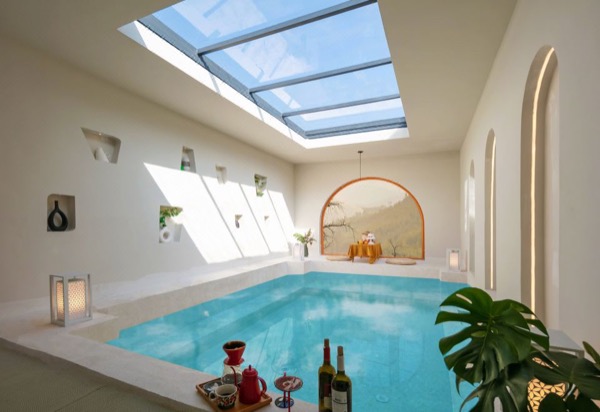
- Pool on 11, hot spring on 5: after late October a pool is scenery, and the hot spring is the scarce item of the season.
7. Cutting 22 hours into blocks you can actually use
Day one: rooms at 14:00 (the 5 properties that open at 15:00 cost you an hour immediately). 14:30–17:30 outdoors is the only continuous stretch with everyone present, but by late autumn it is dark around 17:20, so it is really about 3 hours. Dinner at 18:00. The evening window opens at 19:30, and its length equals quiet hour minus 19:30. Book a 21:00 property and the party is 1.5 hours; book a 23:00 one and it is 3.5.
Day two: breakfast 07:30, morning block 08:00–10:00 (hiking or the hot spring in this season), pack and out by 12:00.
Total it up: 22 hours in the house, minus 8 hours of sleep, 3 hours across three meals, and 2 hours of showers and packing, leaves roughly 9 waking hours for programmed activity. Of those, 3 outdoor hours are capped by darkness and 1.5–3.5 evening hours are capped by quiet hours. Neither cap is yours to set; the house sets them. That is why quiet hours should outrank the pool on your shortlist.
8. Matching the plan to the city mix and headcount
Turn the reasoning above into bands and it becomes a lookup table.
One line to close: a two-day trip across these three provinces is not an itinerary problem, it is five city clocks problem. The drive-time gap is fixed; all you decide is whether it becomes waiting or an earlier alarm, and how much house you get depends on whether you booked the 20-person band or the 40-person one.
- Hangzhou + Shanghai (24–30): sits in the thickest band, the 42 properties sleeping 20–29. Hangzhou leaves 12:30, Shanghai 11:00.
- Hangzhou + Suzhou (20–26): the 100 properties sit only 98–113 km from Suzhou, a 15.7 km spread. Distance is not a filter here — it changes nothing.
- Shanghai + Nanjing (30–36): past the 30 line, so choose among 7 or shop the 40 band, and settle the evening-event question separately (strictly one property).
- Three cities or more (40-plus): 12 properties qualify, only 4 above 45 people. Also confirm the coach can reach the door, turn around there, and seat everyone at one sitting.
- Hangzhou only: a two-day trip is unnecessary. At 44 km and 1.5 hours a same-day return works. You stay overnight for the evening event, not for the drive.