Choosing a Team-Building Guesthouse near Hangzhou
The same search returns three different products: a scenic-area guesthouse sold by the room, a farm stay too small to hold the group, and a whole villa. Where each one breaks, when not to make the trip at all, and what 100 verified properties leave after four filters.
1. One search term, three different products
People searching for a team-building minsu near Hangzhou are not looking for the same thing. Some want a converted old house with a courtyard by West Lake. Some want a farm building in the Lin'an hills where dinner is cooked over wood. Some want a villa with a pool and a barbecue, entirely theirs for the weekend. All three appear under the same word and behave nothing alike.
Two questions settle it: can the whole building be yours, and can you hold an event indoors, including at night. Applied across the Hangzhou radius, they split the market into three tiers, each with a hard ceiling that money does not remove.
- Type A — boutique guesthouses in scenic areas and the city. Sold by the room, so you book two or three of them. Shared common areas. House rules frequently state no parties or events. Usually no kitchen.
- Type B — farm stays and rural guesthouses in Lin'an, Tonglu and Fuyang. Bookable as a whole building, but the typical property has only 5–8 rooms. Dining rooms and courtyards are often shared with the neighbouring building. Activities depend on the outdoors, with no wet-weather backup.
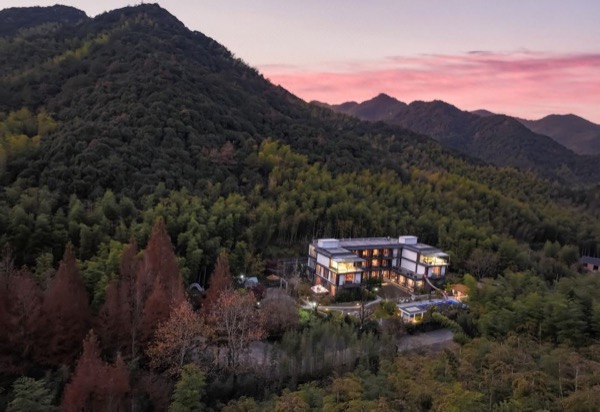
- Type C — whole-villa rentals around Moganshan, roughly 44 km and 1.5 hours from Hangzhou. The entire building, its own common areas and courtyard. This is what "baodong" actually means.
2. Type A: convenience paid for in fragmentation
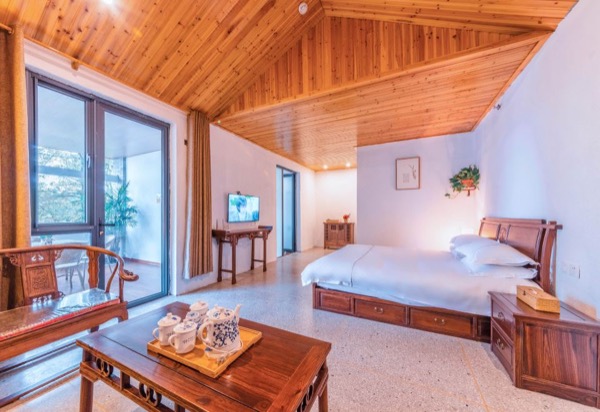
These properties sell location and design — step out into the scenic area, photogenic rooms, good for the group chat. But they are sold by the room. Twenty people means ten rooms, usually spread across buildings or floors.
The house rules are the real obstacle. Boutique guesthouses serve individual travellers and dread a group drinking in the courtyard until midnight, so many state plainly that groups and parties are not accepted. Booking ten rooms does not mean the building is yours; whether you may barbecue together in the courtyard is a separate question with a separate answer.
There is one case where it is right: under ten people, the priority is a beautiful place to sleep, everyone does their own thing by day and retreats to their own room at night. For that it is the best option available. Do not treat it as a team-building venue.
3. Type B: bookable whole, rarely large enough
Farm stays towards Lin'an, Tonglu and Fuyang are the default choice for Hangzhou companies — 1–1.5 hours away, real local cooking, gentle prices. But the product structure caps the headcount: the typical building has 5–8 rooms.
A group of 25 looking for one building that holds everyone will end up viewing four or more. That is no longer a whole-villa booking; it is a village booking. Spread across four buildings, an evening meeting or awards session needs a designated main venue and everyone walking between them, and the next morning's assembly costs half an hour of waiting.
One more thing is easily missed: dining rooms, courtyards and parking are often shared with neighbours. Hot water for twenty showers at once, and two or three bathrooms for twenty people, is a real gap in experience — not a lazy host, but a building designed for one family.
It suits 10–18 people, a tight budget, tolerance for being split across buildings, and daytime outdoors. Past twenty, room count becomes the binding constraint.
4. Type C: whole-villa rental is the real thing
Moganshan holds the densest supply of whole-villa rentals in the Yangtze River Delta, but there is a counter-intuitive finding: "the whole building" is not an advantage here, it is the default. 95 of 100 are whole villas, so asking whether you can book the building filters out nothing. Only three criteria actually narrow the list: capacity, events policy, quiet hours.
Budget the drive honestly as well. Moganshan is about 44 km in a straight line from Hangzhou and 1.5 hours by road. The expressway ends at Deqing; the rest is mountain road, and average speed over the whole trip is around 30 km/h. Plan as expressway distance ÷ expressway speed + a fixed 30–40 minutes for the climb, never from straight-line distance.
We verified 100 properties one by one. The structure looks like this:
- Format: 95 whole villas, 5 whole floors. Not one is sold by the room.
- Capacity: sleeps 10–75. Forty-two take 20–29 people (the thickest band), only 7 take 30–39, and 12 take 40 or more.
- Events and meetings: 84 explicitly allow events; 87 have a meeting or multipurpose room.
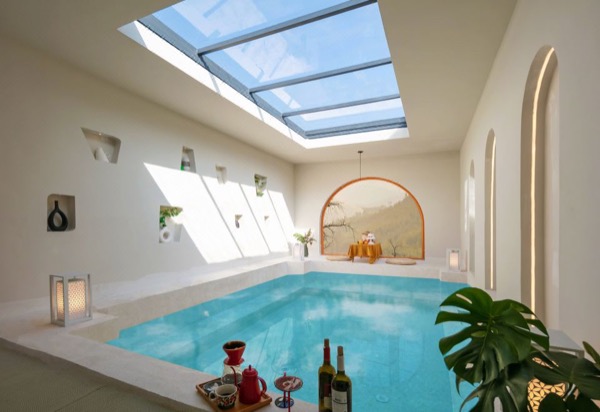
- Facilities: 65 with a pool, 42 with a kitchen, 86 with barbecue facilities, 71 with a mahjong room, 56 with karaoke or a media room.
- Parking and hours: free parking at 100%; 81 check in from 14:00, 90 check out by 12:00.
5. Straight talk: when not to look for a minsu at all
Any article that answers "team-building minsu near Hangzhou" with Moganshan every time is advertising. In the following cases, change track:
- Fewer than ten people. A whole villa is priced per building, so a small group cannot spread the cost. A good restaurant plus one activity venue in the city delivers a comparable day for less. The smallest property here sleeps exactly 10 — that is the line.
- Half a day, no overnight. Three hours of round-trip driving is pure loss and eats the activity time. Look at city venues.
- Someone cannot handle a long drive. Pregnancy, severe motion sickness, limited mobility — 1.5 hours of winding mountain road is a real burden, and the bends are constant.
- A very tight budget. The nightly rate may not be high, but add a coach or fuel and tolls and the total usually exceeds a city plan.
- You need standard conference service. Projector, whiteboard, U-shaped table, coffee breaks, a registration desk, a dedicated contact. A multipurpose room is not a conference room. 87 properties have meeting space; that does not mean 87 can host a meeting.
- You just want dinner and karaoke. The city does this better, without argument.
6. Four filters turn 100 into 13
This is the section worth remembering. Each criterion alone looks generous: 42 sleep 20–29, 84 allow events, 65 have a pool, 42 have a kitchen.
Real trips never satisfy just one. Stack them: events plus pool leaves 57; add a kitchen and it is 27; add a capacity of 20–29 and it is 13. Push the headcount past 30 and it is 2.
Criteria multiply, they do not add. The longer your wish list, the faster the shortlist collapses — and it collapses off a cliff, not gradually. So do not write ten requirements and filter. Fix the headcount and the date first, keep only two non-negotiable criteria, and treat the rest as bonuses. Otherwise you end up with an empty list and the false conclusion that Moganshan has nothing suitable.
One estimating rule saves a round of messages: across the 77 properties with bedroom data, sleeps ÷ bedrooms has a median of 2.4 people per room (range 1.5–3.6). Twenty people is roughly eight bedrooms, not ten. Estimating with "bedrooms × 2" understates capacity by about a fifth, because duplex and tatami rooms sleep more. Seventy-two allow an extra bed and 28 explicitly do not — ask before you overfill.
7. Match the headcount
Condensed into bands, so you can read straight across.
- Up to 10: do not drive out. A city or scenic-area guesthouse is the better fit.
- 10–19: farm stays in Lin'an and Tonglu will do; Moganshan has 39 properties in this band. If you want a whole building, a pool and permission to hold events, go straight to Moganshan.
- 20–29: the sweet spot, with the thickest supply (42). Filter on events plus kitchen first, then choose from the 13.
- 30–39: local options are effectively gone, and only 7 properties sit in this band. Look at houses sleeping 40 or more and put a smaller group in a larger house for headroom.
- 40+: only 12 can take you, and you must confirm both coach access to the village and one table seating everyone. Book a month ahead or more.
8. Seven questions before you call
Each of these concerns something a listing says it has but may not actually let you use. Ask in order; the answers tell you whether the house works:
- "Is the whole building ours, or have we booked only some rooms?" — Confirm the building, not availability.
- "How late can we go, and is there a decibel limit or quiet-hours clause?" — 25 set 22:00, 18 set 23:00, 9 set 21:00, and 38 have no clause at all.
- "Is there a surcharge for holding an event, plus cleaning fee or deposit?" — 84 allow events, but the fee structures differ.
- "How many burners can we use, is open flame allowed, and what is the cleaning fee?" — A kitchen is not the same as being able to cook.
- "Is there one table that seats all of us at once?" — Two tables means two separate events.
- "If it rains, how many people fit indoors?" — This decides whether a plan B exists.
- "After 12:00 check-out on Sunday, may we keep using the common areas for an hour?" — 90 require check-out by 12:00, and many groups are caught out here.