How to Arrange Corporate Team Building from Hangzhou
Corporate team building is a procurement process, not a day out: an approval chain, a budget line, and a rooming list. The hard limits of each distance band, six cases where Moganshan is the wrong answer, and how many twin rooms "sleeps 30" really means.
1. Corporate team building is not the same as a department outing
A department outing is a dozen people finding a house for one night; it can be decided in an afternoon. Corporate team building needs a project first — a budget line, an approval chain, an invoice header, a headcount range, and usually one extra requirement: a meeting has to happen. Quarterly review, strategy alignment, annual kick-off, onboarding. The two buy different things. A department outing buys atmosphere; a corporate trip buys a meeting and a night's accommodation in the same building.
So answer one question before anything else: is there a meeting this time? If yes, meeting space is a hard filter — 87 of the 100 verified properties list a meeting or multi-function room. If no, that number is irrelevant to you and you should be looking at grills, KTV and mahjong rooms instead. Moganshan sits 44 km in a straight line from Hangzhou, about 1.5 hours by road — the only origin city that can do a day trip. Corporate trips still almost always stay overnight, because a meeting plus a dinner does not fit in half a day.
2. Four distance bands from Hangzhou, each with one hard limit
Lay the options out by drive time and there are four bands. Every one of them has a limit you cannot negotiate away:
- City hotels (0–10 km): the most standard meeting service — whiteboards, coffee breaks, printing, a staff member running the room. The limit is the evening: after ten, neither the lobby nor the terrace takes a group, and there is no barbecue, unless you buy out 20 rooms.
- Suburban resorts (20–40 km; Liangzhu, Xianghu, Fuyang): strongest meeting facilities, fixed catering packages, highest price. The limit is that "whole villa" rarely exists, and you cannot cook — every meal is the hotel's.
- Lin'an and Tonglu (80–110 km, 1.5–2 hours): wilder landscape than Moganshan. The limit is supply: whole-villa properties sleeping 30+ are rare, and neither facilities nor availability are verified to a common standard.
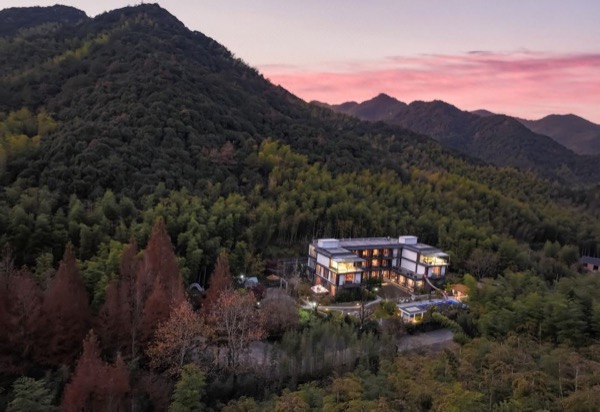
- Moganshan (44 km, about 1.5 hours): 95 of 100 are whole villas, 87 have meeting space, 42 have a kitchen. The limit is the last 30–40 minutes, which is continuous mountain road.
3. Moganshan wins on three things being true at once, not on scenery
Moganshan holds its place in Hangzhou corporate planning for one reason: the whole house is yours, there is a room you can hold a meeting in, and you can cook a meal yourselves — all three at the same time, and cheaper than a resort of the same standard. City hotels fail the first, resorts fail the third, and Lin'an/Tonglu fail the first inconsistently.
Follow that logic one step further and you can see when Moganshan should not be chosen at all. That is the right order for a selection decision: rule things out first, and what remains is the shortlist.
4. Six cases where Moganshan is the wrong answer
This is the section the article should be judged on. In each of these cases Moganshan is not second best — it is simply wrong:
- A one-day meeting with no overnight stay. Three hours of driving for a meeting room, when a city hotel is twenty minutes away with better equipment.
- Fewer than 10 people. A whole villa is priced per house, not per head. The smallest property here sleeps 10, so eight people are paying for two empty rooms.
- A budget under 300 RMB per person. A whole villa bundles accommodation and meals. Below that line you are back to farmstays, which is a different product.
- Someone in the group cannot take a long drive. The last 30–40 minutes is unbroken mountain road. For anyone prone to car sickness that is the worst stretch of the trip, and there is no alternative transport.
- You need standard meeting service — coffee breaks, printing, whiteboards, someone running the room. These houses are run by owners, not by a banqueting department. You bring it or you do without.
- A half-day programme. Leave in the morning, return in the afternoon, spend under three hours in the house: the nightly rate divided by hours becomes absurd.
5. Headcount is the first gate: from 42 properties down to 7
The 100 verified properties sleep 10 to 75, but the distribution is very uneven: 39 sleep 10–19, 42 sleep 20–29, only 7 sleep 30–39, and 12 sleep 40 or more.
Twenty-two to twenty-nine people is the comfortable band, with 42 properties to choose from. Crossing 30 is not a gradual thinning — it is a cliff: the 30–39 band has 7 properties left. And 30–40 is the most common size for a corporate trip. At that size you can pick almost anywhere else around Hangzhou; in Moganshan only 19 properties can take you.
The good news is that all 19 have meeting space, so a large group need not worry about the meeting. The worry is beds. Above 40 people there are 12 properties, five of which sit exactly at 40 — a real margin of 0 to 2 people. Book for 40, turn up 42, and half the shortlist is out.
6. The real constraint is not "sleeps 30" but "how many twin rooms"
This is where corporate trips differ most from family trips: colleagues share by default, two of the same sex to a room, which needs two beds. None of that is visible in the number "sleeps 30".
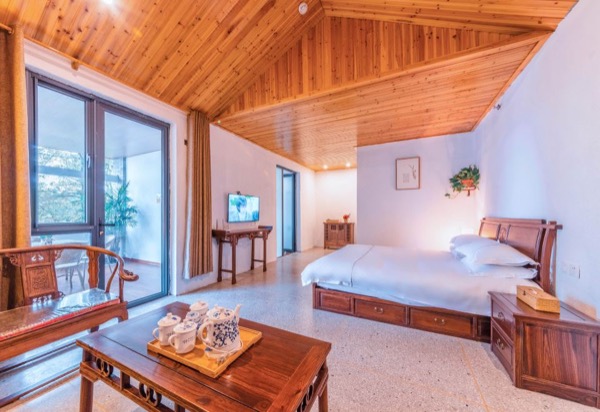
Of the 91 properties with parseable room data, there are 639 accommodation units in total. Only 320 of them — 50% — take two people (twin or multi-bed). The other 319 have a single large bed. In a house advertised as sleeping 30, if 8 of 15 units are king rooms, the rest of the group is on tatami, on extra beds, or alone in a room — and the rooming list collapses.
There is a subtler layer. Divide capacity by bedroom count across the 77 properties with bedroom data: the median is 2.44 people per bedroom, 32 exceed 2.5, and 5 exceed 3 (the highest is 3.57). Those "sleeps 30" figures are built out of tatami and rollaway beds; it will feel closer to a hostel. Two properties have no twin unit at all — every bed is a king. Those are built for couples and families, not for a company.
So the first question to the owner is not "how many does it sleep" but "how many twin rooms, how many king rooms, and how many extra beds can you add". 72 properties can add beds; 28 explicitly cannot.
7. Meeting space is not a meeting: not one property lists a whiteboard
The 87 with meeting or multi-function space break down as: 73 with a conference room, 63 with a multi-function hall, 62 with multimedia presentation equipment, 77 with a public sound system.
But search the entire property database and "whiteboard" appears zero times. "Projector" zero. "Microphone" zero. The reason is not the houses but the source: the upstream platform's facility taxonomy has no such fields.
That gap means "87 have meeting space" only proves there is an indoor floor you can sit on — not that you can run a meeting. The things a company actually needs (whiteboard, flip chart, sticky notes, spare microphone batteries) come with you, or get confirmed item by item on the phone. This is the single line to remember: 87 houses can seat you, and none of them has ever promised you a whiteboard.
8. Plan backwards on a timeline: T-30 to T+1
Corporate trips rarely fail because the wrong house was chosen. They fail because things happened in the wrong order. Work this sequence and the final week stays calm:
- T-30: fix the dates, and write the headcount as a range ("28–32"), never a single number.
- T-21: settle four things in one call — twin rooms, extra beds, whether they can issue a fapiao, and whether payment can be company-to-company or needs an individual to front it.
- T-14: confirm check-in and check-out. 81 properties check in from 14:00, 4 only from 15:00; 90 require check-out by 12:00.
- T-7: settle food. 91 have a restaurant, 86 can grill, 42 have a kitchen — three completely different cost structures.
- T-3: build the rooming list around twin rooms, not by splitting people "two to a room" evenly.
- T-1: ask how many cars fit in the courtyard (parking is free at all 100, but capacity varies hugely), and do not set "Moganshan Scenic Area" as the navigation destination.
- T+0: the three-odd hours before the 14:00 key handover are time without a house. Use them for the meeting or for the scenic area.
- T+1: check out at 12:00; 95 properties store luggage, which matters for a group with half a day left.