Three Generations on One Trip: Sort the Floor First
All 100 verified villas, re-sorted by vertical circulation: 82 have three or more floors but only 6 have a lift, only 63 offer a ground-floor room with twin beds, and the 41 tatami rooms and 120 bathtubs are exactly what older guests handle worst. Includes the room-allocation order and nine questions to ask the host.
1. Assign the ground floor before you discuss the view
Most families start with how many rooms there are, whether there is a garden, and what the view looks like. All three are answered by the photos, which is why they are easy to ask. The question that becomes a problem on the second morning is different: how many steps lie between where the car parks and the side of the bed.
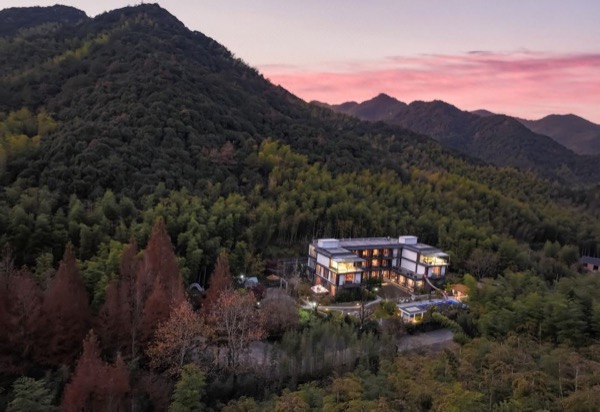
Across the 100 properties, 82 have three floors or more (62 with three, 19 with four, 1 with five), 17 have two, and exactly 1 is single-storey. Only 6 properties list a lift - which means 78 of those 82 multi-storey houses have none. These are not office buildings: the stairs are outdoor stone steps or narrow indoor timber flights, often with no landing halfway.
So the allocation should not start with who gets the master bedroom. It should start with which ground-floor room the grandparents take, and work backwards. A view, a terrace or a stargazing roof affects one photograph; a staircase affects every trip up and down for three days.
2. The usual three-generation split: only 63 properties can do it in one go
The typical group is six to eight people: grandparents in one room, one couple with a child in another, a second couple with a child in a third. There is an assumption buried here that quietly breaks trips - the grandparents need two single beds. Most older couples do not share a bed, and separate beds also mean neither is woken by the other getting up at night.
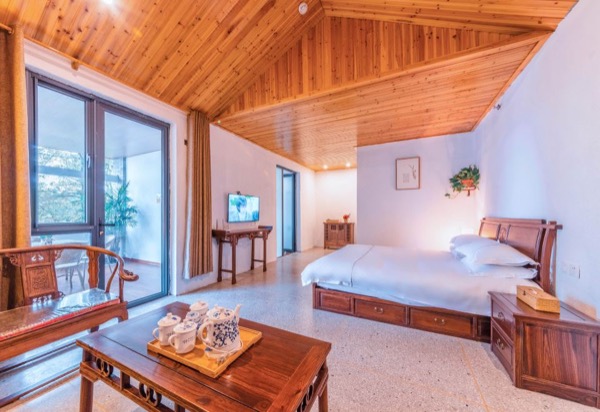
Stack the two conditions, ground floor and two single beds: 91 properties have a ground-floor room, but only 63 have a ground-floor room with twin beds. Of the 895 room types on the site, just 192 have two single beds, against 308 with a single large bed - the default in this category is one big bed, and twins are the minority. Twenty-four properties have no twin room at all.
- First priority: ground floor plus two single beds. Sixty-three properties can answer yes; settle this before anything else.
- If a child is to sleep in the grandparents room, you need two twin rooms on the ground floor, and the shortlist drops to single digits.
- The couple takes a large bed, which 92 properties offer. This is rarely the constraint.
- Leave the tatami rooms to the youngest adults: 41 tatami rooms across 26 properties sit on a raised platform with a narrow edge, which is exactly what makes standing up hard.
3. Asking about a lift is the wrong question
Ask about a lift and you will usually hear that there is none but the house only has two floors. Replace it with three concrete questions: how many steps from where the car stops to that room, are they indoors or outdoors, and is there lighting at night?
The accessible hardware on the site is bleak: a lift in 6 properties, stair handrails in 4, corridor handrails in 3, a step-free path in 1, a pool ramp in 1. Any one of those five appears in 12 properties total. In other words, accessibility barely exists in this category and it is not worth hunting for a genuinely age-friendly house.
Where hardware is missing, people fill the gap. Luggage storage appears in 95 properties, concierge in 46, a dedicated porter in 39, valet parking in 55 - and the 55 with valet parking are worth prioritising, because it means the car can pull up to the door to unload passengers and bags instead of leaving an older guest to walk up a slope from a car park. Only 3 properties run a shuttle, so do not plan around one.
4. What is on the other side of the ground-floor wall
This is the part most people miss: ground-floor rooms tend to share a floor with the communal spaces. The site lists 71 properties with a mahjong or games room, 56 with a karaoke room, 86 where you can barbecue, and 87 with meeting or multi-function space - and most of that sits on the ground floor or in the courtyard. Put the grandparents downstairs and you save them twenty steps, at the possible cost of sleeping next to the speakers.
Older guests keep fixed hours and are usually asleep by nine. So the question is not whether the house is noisy but what is on the other side of that wall, and whether a door separates you from it. A host who cannot answer that clearly should drop a tier.
On quiet hours: 38 properties state no quiet policy at all. Of those that do, 25 start at 22:00, 18 at 23:00, 9 at 21:00 and 3 at midnight. For a group with children and grandparents, the 34 properties that go quiet at 21:00 or 22:00 are a plus - the rule binds the neighbours, not only you.
5. A hundred and twenty bathtubs: a selling point and a hazard
Bathrooms with a bathtub appear in 49 properties and 120 room types; private hot-spring tubs in 15 properties and 32 rooms. Both are genuine selling points and genuinely pleasant. For anyone over seventy, though, the real issue is the step in and the step out: a wet rim, no grab rail, a curved base.
Check the other column: the site records zero entries for non-slip flooring, zero for a shower chair, zero for an accessible bathroom, and only 5 properties with a smart toilet. So the test is not whether there is a bathtub. It is whether there is one bathroom that is shower-only, with a floor that does not slide and no threshold at the door. Hosts can usually answer that immediately.
- For the grandparents, prefer a walk-in shower over a tub - including private hot-spring rooms, where what matters is how you get in.
- Ask whether the shower floor is ordinary tile or non-slip tile. It is the cheapest and most effective single difference.
- Walk the night route: is there a light between bed and bathroom, and is there a threshold in between?
6. The children half: be careful with rooms that have their own stairs
Children carry the opposite risk - they climb. The site has 19 properties with duplex rooms, 15 with lofts, 4 with attic rooms and 4 with slide rooms. For a five-year-old these are a bonus; for a two-year-old they are a hazard, because the in-room staircase usually has no stair gate and the slide lands in the middle of the living room.
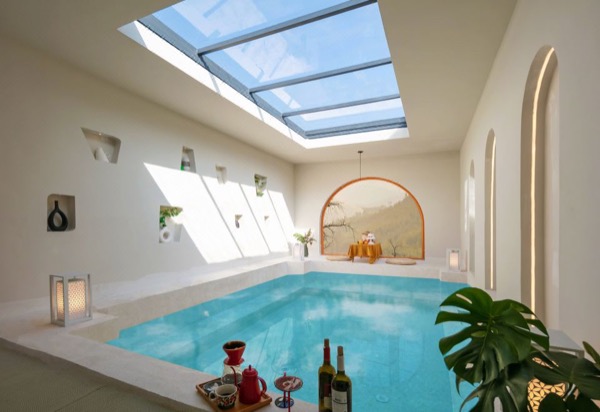
Pools deserve one line too: 65 properties have one, but every pool is outdoors and none is indoors; 10 list a children pool and 8 explicitly restrict theirs to adults. From late October the pool drops out of the decision entirely, and the 24 properties with hot springs matter more.
That gives a simple rule for a three-generation trip: give the room with stairs to the youngest couple, and keep both the grandparents and the children on the same floor, so one floor handles both bedtime and night-time trips.
7. Food and hospitals: two coordinates to fix in advance
Feeding the oldest and the youngest are two different jobs - one needs less salt and oil, the other needs soft, mild food. The 42 properties with a kitchen are the only setup that satisfies both; 91 have a restaurant and 46 offer room service, but only 30 list children meals. For six to eight people, one breakfast cooked in-house beats ordering in.
The other coordinate is a hospital. The county hospital sits in Wukang; the median straight-line distance from the 100 properties is 11.4 km, only 29 are within 10 km, and the furthest is 20.4 km. At an average mountain-road speed of 30 km/h that is 25 to 40 minutes each way. If anyone in the group manages a chronic condition on a fixed medication schedule, this number matters far more than proximity to the scenic area.
Then the time container: 99 properties hand over rooms at 14:00 or later and 98 want you out by 12:00, so one night is a 22-hour stay. Three generations move slowly - plan to arrive around 13:50 rather than in the morning, or you will spend two hours waiting in the courtyard.
8. Rule out two cases first, then make the call
To be honest: if an older guest uses a wheelchair, or needs to rest after ten minutes of walking, none of the 100 properties is a good answer - there is one step-free path, three corridors with handrails, and no pavement along the mountain roads. A suburban resort hotel fits that brief better. The other case is headcount: whole-house rentals start at 10 guests with a median of 20, so a family of six pays for ten; for a single night spent eating and talking, that premium buys little.
If, on the other hand, three conditions hold - the group is between 10 and 20, the grandparents can manage stairs, and you are willing to put which floor above which view - a whole-house rental remains the easiest form for three generations: one house, one courtyard, one kitchen, no other guests for the children to wander into, and no corridor in which an older guest has to find the right door.
After that, everything rests on nine answers from the host. The first four decide whether the house is even a candidate; the last five decide whether the stay runs smoothly.
- "Is there a ground-floor room with two beds?" Sixty-three properties can say yes. Clear this gate first.
- "How many steps from the parking spot to that room, and are they indoors?" Far more useful than asking about a lift.
- "What is next to the ground-floor room - karaoke, games room, or the courtyard?" It decides whether the grandparents sleep.
- "Is there a bathroom that is shower-only, with no tub to step over?" A bathtub is a selling point, not an advantage.
- "Are the steps and corridor lit at night? What is the route for a night-time trip?"
- "Can a car pull up to the door to unload? Is the valet parking an actual person?" Fifty-five properties list it.
- "What time can we use the kitchen in the morning, and are pots and dishes provided?" Forty-two have a kitchen; consumables are not recorded anywhere.
- "If an older guest feels unwell at night, where is the nearest hospital and how long is the drive?" Median 11.4 km, only 29 within 10 km.
- "After the 12:00 checkout, can the grandparents sit in the restaurant a while longer?" Ninety-eight want you out by noon, and three generations never pack on time.