How to Plan a Day Trip to Moganshan
The real cost of a day trip is travel time, not fuel. Working back from a 5–6 hour round trip from Shanghai: who should come, which single half-day route to pick, and the five questions to settle before you leave.
1. Turn "half the day is driving" into actual hours
Most people plan a day trip as if they get a full day on site. Moganshan is not close to the big cities: about 200 km and 2.5–3 hours each way from Shanghai, around 180 km and 2–2.5 hours from Suzhou, roughly 250 km and 3 hours from Nanjing. Hangzhou is the exception at 60–80 km and 1–1.5 hours.
Convert that into a day. Leaving Shanghai at 07:00, you arrive around 10:00 including parking and finding your way, and you need to head back by 16:30 — 6.5 hours in Moganshan in total. Subtract an hour for lunch and roughly an hour of driving between points and you are left with about 4.5 hours actually standing somewhere. From Hangzhou it is better, but still only 6–7 hours.
The point of the arithmetic is not to put you off. It is that one day buys you one activity. Every "we could also pop over to…" ends up being spent in the car.
2. Moganshan is not one scenic area — it is a scattered resort district
This is the most common misjudgement. On a map Moganshan looks like a single site. In reality it is "the mountain area plus several villages at its foot": the pool and the viewing terraces sit up on the mountain, while Yucun, Laoling and Xiantan are separate clusters below, each 15–30 minutes apart by road.
Of the 100 whole-villa properties we list, 69 are inside the Moganshan International Tourist Resort and 28 sit on its periphery — the same word, "Moganshan", can mean places more than ten kilometres apart. People behave the same way: what looks like three stops in one area is really three mountain drives.
So there is one rule: half a day = one main activity plus one stop on the way, and no more. Mountain roads are slow; treat satnav estimates as 1.5× when planning.
3. Three groups who should come, three who should not
A day trip is not "Moganshan with less time". It is a different kind of trip. Use this list to decide which one you are planning.
- Come if: you are local to Hangzhou or Huzhou and can arrive by midday — driving takes half a day at most.
- Come if: you are passing through anyway on business or a longer road trip via Deqing or Anji.
- Come if: you are scouting for a future team trip. Skip the sights, see two or three candidate properties instead — that half-day pays off within three months.
- Do not come if: you are a group of 20 or more. Boarding, counting heads and waiting for latecomers alone eats two hours, leaving time for little more than a meal.
- Do not come if: you want to hold an event. A day trip has no evening, and the evening is the most valuable part of a whole-villa stay.
- Do not come if: you are travelling with elderly relatives and small children. The pace is essentially a relay of drives.
4. How to use the half-day: three routes, pick exactly one
With only half a day, routes are single-choice. These three cover most situations.
Route A — Yucun, the easiest. Yucun is the lowland hub: cultural market, cafés and old lanes all within walking distance, 1.5–2 hours in total. We list 55 properties with a café and 91 with dining — many of them around Yucun, which is why the village reads more like a small town than a scenic gate. Right for anyone who wants to wander rather than hike.
Route B — the mountain sights, the classic. The pool and the viewing terraces are the two names everyone knows; walking and stopping takes about two hours. It is also the route with the most variables: narrow roads, high-season queues, scarce parking. Choosing it means the whole day is for this one place — plan no second stop.
Route C — scouting, the highest return. Skip the scenic area entirely and visit two or three shortlisted properties to see the yard, the rooms and the dining space. The test is simple: if this is your only Moganshan trip this year, take B; if you are bringing a team within three months, take C.
5. The three places a day trip most often falls apart
A day trip has far less margin than an overnight stay: with a night booked you can recover from a wrong turn, without one the whole day is wasted. Settle these three before you leave.
Parking. You cannot park on the mountain roadside, and interior car parks fill by mid-morning in high season. On a pure day trip, park in the public area at Yucun and walk or transfer. If you have a room booked for that night, ask the host how many cars fit in the yard — all 100 of our properties offer free parking and 62 also have EV charging bays, so electric drivers need not hunt for a charger.
Lunch. The peak is around 11:30 and parties of 20 or more often wait a full turn without a reservation. Either arrive before 11:30 or book a day ahead; otherwise queuing quietly eats an hour of your half-day.
Tickets and the drive home. The scenic area sells tickets and requires booking on peak dates. 76 of our properties list guided-tour and ticket services and can arrange both; if you are not driving, 82 offer a taxi-call service. And note the light: from autumn into winter it is dark by about 17:30, so mountain driving needs extra time — do not leave the return later than 16:30.
6. If you are really considering staying the night: check 14:00 and 12:00 first
Many people assume the only difference between a day trip and an overnight stay is one night’s room rate. What actually separates them is two times: of our 100 properties, 81 list check-in after 14:00 and 90 list check-out before 12:00.
That makes the "arrive in the morning, have lunch, then check in" plan — which sounds perfect — unworkable. Before 14:00 you cannot get into the room, and you cannot really use the yard or the pool either. Those morning hours go to sights on the road, not to the property you paid for.
More decisively, if you plan to hold an event a day trip is not an option at all. 84 of our properties explicitly allow events, but quiet hours break down as 22:00 for 25 properties, 23:00 for 18, 21:00 for 9, and 38 with no fixed limit. Permission to hold an event is not permission to stay up — the hours when you can actually make noise sit between dinner and curfew, and those are precisely the two or three hours that only exist if you stay.
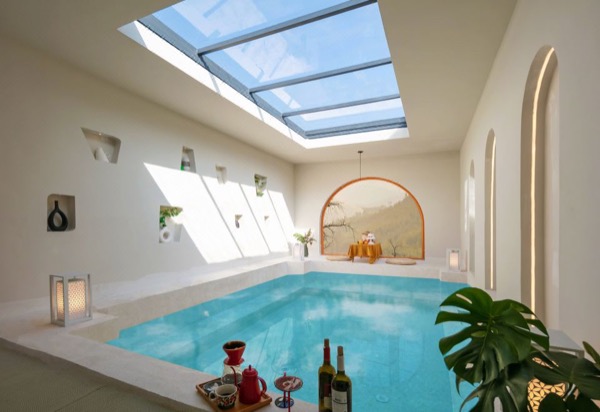
The same goes for the 42 properties with kitchens and 65 with pools: a day trip never touches them. Which is the whole argument: what Moganshan is worth is not passing through it, but moving half a day out of the car and into the courtyard.
7. Five questions to settle before you set off
Compress the article into five sentences and ask them — of yourself, or of the host — before departure. That is usually enough for a day trip to run cleanly.
- "What time can we arrive, and what time must we leave?" — fix both first; everything in between is your real budget.
- "Where do we park?" — Yucun public parking for a pure day trip; if you have a room, ask how many cars the yard takes and whether there is a charger.
- "Is lunch booked?" — arrive before 11:30 or reserve the day before. Do not build a queue into the plan.
- "Which single main stop are we doing today?" — choose one and drop the rest.
- "Will we bring a team here within three months?" — if yes, turn the half-day from sightseeing into property scouting and lock in the venue for the next trip.