How to Choose a Team-Building Venue in Moganshan
Seven workable criteria — headcount, villa format, events policy, quiet hours, dining, transport and invoicing — for organisers choosing a team-building venue in Moganshan.
1. Settle the headcount first
Every venue question comes back to headcount — but "headcount" has three different meanings, and mixing them causes problems: the number who signed up, the number who actually turn up, and the number staying overnight (some leave the same evening). The last two are what you should plan around.
A practical rule is to plan for "expected maximum + 2". Late additions are normal on a team trip, and most whole villas state plainly that no extra beds are available in any room type.
- Look at bedrooms, not just "sleeps N": 20 people across 8 rooms and 20 across 4 rooms are entirely different experiences.
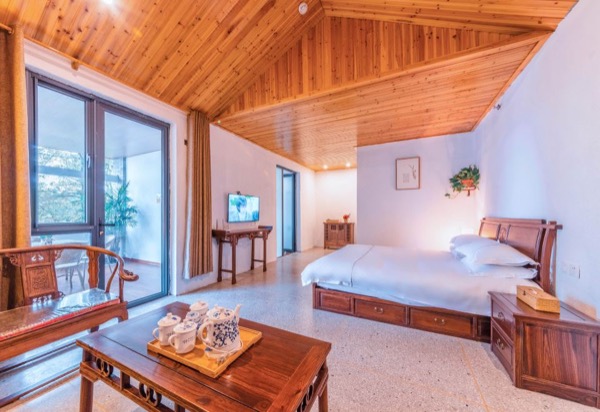
- Check the bed configuration: a property with nothing but king beds is awkward for two colleagues sharing.
- Confirm the extra-bed policy: where extra beds are not allowed, the headcount must stay strictly within the limit.
2. Confirm whether you can host events — the most common failure
In Moganshan, a good number of properties state in their check-in policy that parties and events are not permitted. It sits in the policy panel of the listing, and many teams only find out on arrival.
Subtler still: even where events are allowed, quiet hours usually apply. A villa that permits events but requires quiet from 21:00 gives you roughly late afternoon to nine.
- Read the policy text in advance — do not rely on "we get team groups here all the time".
- Write quiet hours into the itinerary: if it starts at 22:00, put the group photo, the awards and the late-night chat before dinner.
- Mountain properties usually have neighbours; keeping the volume sensible protects both your deposit and your reputation.
3. Dining: the biggest hidden cost
For groups of 20 or more, eating out in Moganshan requires booking ahead — in high season a table is genuinely hard to find. Whether the property has a kitchen and a restaurant therefore decides how comfortable your trip is.
Self-catering properties let you shop and cook at roughly half the per-head cost of eating out, and cooking together is the best icebreaker there is. But check the kitchen: a corner for boiling noodles cannot produce ten dishes.
- For 20+, prioritise properties with a restaurant or a full kitchen.
- Buy supplies in one trip in Deqing town or Yucun — supermarkets inside the scenic area are limited and expensive.
- If you hire a chef, agree the fee and menu with the host in advance.
4. Transport and itinerary pace
Moganshan is about 1.5 hours from Hangzhou, 2.5–3 hours from Shanghai and 3 hours from Nanjing. High-speed rail reaches Deqing or Deqing West station, with a further 20–40 minutes by road.
Two days and one night is the most common and most comfortable format: arrive in the afternoon, activity in the evening, outdoors the next morning, home after lunch. If you need a formal meeting, plan two full days — otherwise, once travel and meals are deducted, you have three or four usable hours.
5. Invoices and expenses (essential for company trips)
Company trips need a proper invoice, and some properties — especially individually run standalone villas — cannot issue one, or can only issue a particular type. Confirm this before booking; sorting it out afterwards is often impossible.
6. Parking: several families means several cars
A group of 20 typically arrives in 4–6 cars. Most properties advertise "free parking", but the actual capacity may be only 2–3 spaces. Ask for the number, not the claim.
- Ask exactly how many vehicles fit.
- If you are coming by coach, tell the host in advance — parts of Moganshan are narrow and have height limits.
7. Reviews need a sample size
There is an easily missed precondition to any rating: how many reviews it is based on. A 9.8 from three reviews and a 9.2 from three hundred are not comparable in reliability.
We flag properties with fewer than five reviews as having limited review data. When choosing, treat a low sample size as a reason to ask more questions on the phone, not as a reason to trust the number.