Where to Take a Team Trip in the Yangtze Delta
A framework for choosing a team-trip destination across Jiangsu, Zhejiang and Shanghai: four bands by one-way drive time, an honest list of when Moganshan is the wrong call, and verified data from 100 whole-villa listings.
1. Ask the right question first: there are only three variables
Search for team-trip destinations in the Yangtze Delta and you get a long list of place names — Moganshan, Anji, Tonglu, Qiandao Lake, Tianmu Lake, Chongming, Taihu. That list answers "where is the scenery good". It does not answer what actually decides the outcome, which comes down to three variables.
- One-way drive time — it settles two things at once: whether you can go there and back in a day, and whether anyone is going to be carsick on the coach.
- Supply format — is it the whole property for your group, or a few rooms with a shared courtyard?
- Trip length — half a day, one day, or two days and one night. Change this and the best answer to the first two changes with it.
2. Four bands by one-way drive time
Treated as a single region, the options sort into four bands. Use this to draw your shortlist.
- Under 30 minutes (city centre): restaurants, KTV, escape rooms, hotel meeting rooms, sports halls. Convenient, but it cannot host an overnight.
- 1–1.5 hours (inner suburbs): Lin'an, Tonglu and Fuyang west of Hangzhou; Chongming, Dianshan Lake, Jinshan and Lingang around Shanghai; Taihu and Yixing across the provincial border. Overnight is possible, but whole-property listings are scattered and mostly small.
- 2–3 hours (outer ring): Moganshan, Anji, Qiandao Lake, Tianmu Lake, Xiangshan. This band is the dividing line where an overnight stop becomes mandatory.
- Over 3 hours: Huangshan, parts of Zhoushan. Only worth it for genuine destination trips; for a team-building event it rarely pays off.
3. "Two hours" does not mean the same thing everywhere here
This is the one point in the article worth remembering. Almost every candidate destination in the Yangtze Delta falls inside the same 1.5–3 hour window, so "half an hour shorter" is not a real differentiator. What differentiates them is how much of that time is motorway and how much is mountain road.
Two real numbers make it obvious. Suzhou to Moganshan is about 103 km straight-line and about 2 hours, and most of those 2 hours are motorway. Hangzhou to Moganshan is only about 44 km straight-line and still takes 1.5 hours — because the motorway ends at Deqing and everything after that is mountain switchbacks, where the average speed is about 30 km/h.
- How to budget the time: total drive time = motorway distance ÷ motorway speed + a fixed 30–40 minutes for the mountain section. Estimating with straight-line distance ÷ 60 badly understates it.
- What to ask on one phone call: ask the host "how is the road from the motorway exit to your door, and how long does it take?" That is far more useful than asking how far the property is from the city.
- When this matters most: if anyone in the group is pregnant, prone to severe carsickness, or has limited mobility, the final 30–40 minutes of switchbacks becomes an absolute veto. And if you are booking a 50-seat coach, separately confirm that it can reach the door and turn around.
4. Supply format decides the experience more than the scenery
There are only two product lines for overnight team trips in this region: the shared resort or farmhouse (rooms sold individually; dining room, courtyard and activity areas shared with other guests) and the whole-villa rental (the property is yours, indoor and outdoor areas are private, priced per property rather than per head).
The scenery barely differs between the two. The experience does. At a shared property, the barbecue you hold in the courtyard may be happening next to another family's dinner, and late-night volume has to respect other guests. A whole-villa rental removes that layer entirely — how late you play depends only on that property's own rules.
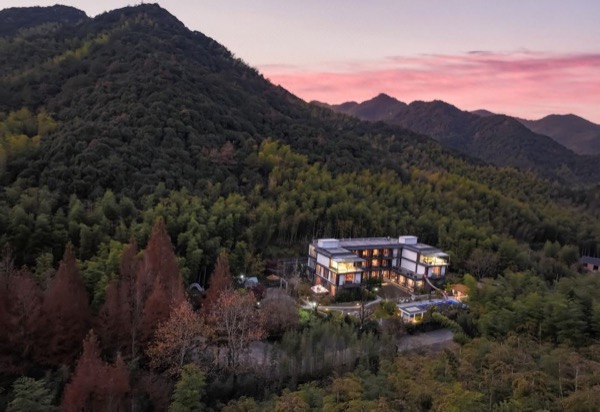
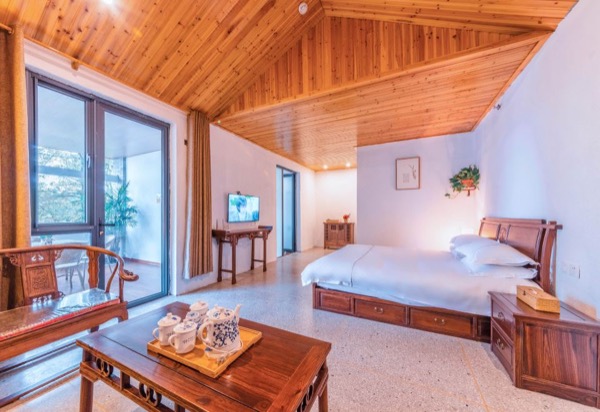
The densest concentration of whole-villa supply happens to sit near the geographic middle of the region. We verified 100 listings in Moganshan one by one: 95 are rented as an entire property and 5 as an entire floor, with not a single room-by-room listing. That is why Moganshan is hard to avoid in this discussion — not the scenery, but the concentration of supply format.
5. Honest section: when Moganshan is the wrong call
If this article answered "where to take a team trip in the Yangtze Delta" with Moganshan every time, it would be worthless. In the following cases, save yourself the trip.
- Fewer than 10 people. A whole villa is priced per property, so a small group cannot spread the cost. At that size a good restaurant plus one activity venue in the city costs far less and is just as enjoyable.
- Half a day only, arriving and leaving the same day. The round-trip drive is pure overhead — and since most properties check in after 14:00, a same-day visit cannot really use the villa at all.
- Someone in the group cannot handle a long drive. It is 1.5 hours from Hangzhou and 2.5–3 hours from Shanghai, with switchbacks in the last 30–40 minutes either way. Factor that in early.
- A very tight budget. The nightly rate may not exceed a city plan, but once you add a chartered coach or fuel and tolls for self-driving, the total is usually higher — a 50-seat coach round trip is not a small line item.
- You only want dinner and karaoke. The city covers that completely; there is no reason to travel.
- You just want a night away with a change of scene, and you are under 20 people. Pick somewhere closer: Chongming or Dianshan Lake from Shanghai, Lin'an or Tonglu from Hangzhou, all of which can host an overnight. Moganshan's advantage is the density of whole-villa supply, which a small group cannot use — the extra drive time is pure cost.
6. Where Moganshan actually sits in the region
Placed on that map, Moganshan sits at the boundary of the "2–3 hour outer ring": from Hangzhou it is just about feasible as a day trip, while from Suzhou, Shanghai, Ningbo and Nanjing it requires two days and one night. Measured from the 100 verified listings: Hangzhou about 44 km straight-line (range 29–55 km), about 1–1.5 hours by car; Suzhou about 103 km (98–113), about 2 hours; Shanghai about 168 km (156–177), about 2.5–3 hours; Ningbo about 179 km (161–188), about 2.5 hours; Nanjing about 193 km (182–209), about 3–3.5 hours.
What keeps it near the top of the list is the supply data below — all of it from our 100 verified listings and not available elsewhere.
- Format: 95 whole-property and 5 whole-floor listings; none sold by the room.
- Capacity: sleeps 10–75. 42 properties sleep 20–29 (the thickest band), 39 sleep 10–19, only 7 sleep 30–39, and 12 sleep 40 or more.
- Events policy: 84 explicitly allow events. This is the easiest thing to get wrong — plenty of properties state that parties and events are not permitted.
- Meeting space: 87 have a meeting or multi-function room, so meeting by day and switching to an activity space at night is workable.
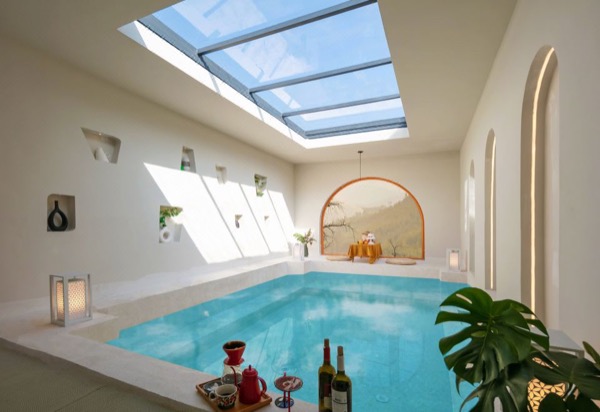
- Facilities: 65 with a pool, 42 with a usable kitchen, 86 with barbecue facilities, 71 with a games room, 56 with KTV or a home-cinema room.
- Parking: 100% free parking, mostly inside the grounds.
- Schedule: 81 check in after 14:00, 90 check out before 12:00; 72 allow an extra bed and 28 do not.
- Quiet hours: 25 start at 22:00, 18 at 23:00, 9 at 21:00, and 38 set no clause at all.
7. Two time calculations almost everyone gets wrong
From any city in the region there are two numbers nearly everyone gets wrong the first time, and both decide whether the itinerary actually fits. One more warning while we are here: "check-in time" and "how late we can play" are two completely different things, and many organisers only confirm the first and think the job is done.
- Myth one: "Shanghai to Moganshan is one hour by high-speed rail." It is not. That hour gets you to Deqing station; from there it is another 15–20 km and 25–30 minutes by car to Moganshan town. Add the trip to the station and the wait, and door-to-door is over three hours — and without a car you are stuck once you are up there. For a group, a chartered coach is the better plan.
- Myth two: estimating drive time from straight-line distance. The correct formula is in section 3: total drive time = motorway distance ÷ motorway speed + a fixed 30–40 minutes for the mountain section. Hangzhou's 44 km taking 1.5 hours is the clearest example.
- Myth three: ignoring the exit from the city. The Shanghai–Hangzhou and Hangzhou–Nanjing corridors jam on public holidays and on Friday afternoons; leaving at 07:00 versus 09:00 can mean a two-hour difference on arrival. On a two-day trip that gap is one whole activity deleted.
- One more: quiet hours set your evening window. Dinner at 19:00 and finished by 20:00, and if you booked one of the 9 properties with quiet hours from 21:00, you have a one-hour window. Only the 23:00 group or the 38 with no clause (56 properties together) support "dinner and then a proper evening event".
8. Recommendations by headcount and origin city
The judgements above, as something you can act on directly.
And one closing line: choosing a team-trip destination in this region is not about picking the right mountain. It is about answering three questions first — how long a one-way drive can we tolerate, does this trip need an overnight, and do we need a private whole property or can we share common areas? Answer those and the only thing left is picking the villa. If your answers land on "2–3 hours, overnight, whole property", Moganshan is the hardest band to get wrong in the region. If they land elsewhere, somewhere closer is usually the right choice.
- Under 10 people: skip the outer ring. A city restaurant plus one activity venue is enough.
- 10–19 people: from Hangzhou, the inner suburbs work (Lin'an, Tonglu, Fuyang). From Shanghai, Suzhou, Nanjing or Ningbo, stay in the city or the inner suburbs. If an overnight and a whole property are firm requirements, start looking at Moganshan (39 properties sleep 10–19).
- 20–29 people: Moganshan's sweet spot and the band where a whole villa pays off most clearly (42 options). The 2.5–3 hour drive from Shanghai only amortises at this size. Filter first on "allows events + kitchen or dining room".
- 30–39 people: the city has no answer, so look at properties sleeping 40 or more — a bigger house for a smaller group leaves room for error (only 7 properties in Moganshan sleep 30–39, a very narrow choice).
- 40 and above: confirm coach access to the mountain, turning space at the door, and dining that seats everyone at once. Only 12 properties can take this, so book more than a month ahead.