How to Plan the Route When Travelling with Children
The route question is not which motorway to take but where the child sleeps. Three origin cities, three departure times, why the last 30 km needs a stop before it, and why the return leg runs on the opposite logic. Seven questions for the booking call.
1. The problem is where the child sleeps, not which road you take
When you travel with a small child, the quality of your route planning has almost nothing to do with which motorway you pick. The three options into Moganshan differ by nine minutes on navigation, and nine minutes makes no difference to a child. The real variable is which part of the child day those driving hours fall into.
A child day has two fixed anchors: one nap, roughly between 12:30 and 14:30, and dinner around 18:00. A family itinerary is built backwards from those two points. On this road there is a third anchor, and the host supplies it: 81 properties state check-in after 14:00, and once you add the 4 that say 15:00 and the dozen listing check-in windows, 99 of 100 hand over the keys at 14:00 or later.
Put the three anchors together and you reach a conclusion that is not intuitive: the ideal arrival time is around 13:50, not as early as possible. Arriving two hours early does not buy two extra hours of holiday. It usually means a child woken at the gate, a room that is not ready, and a family waiting in the car. So this guide answers one question only: what departure time makes the drive cover that nap.
2. Three origin cities are really three sleep plans
Measuring to the coordinates of the 100 properties, the three main origins fall into clear tiers: Hangzhou at 1 to 1.5 hours (about 44 km as the crow flies), Suzhou at about 2 hours (about 103 km), and Shanghai at 2 hours 10 minutes to 2.5 hours (192 to 194 km measured, 127 to 136 minutes). These numbers do not describe distance. They describe three different ways to plan the day.
Shanghai: the only distance that covers a full nap. Leave between 10:30 and 11:00 and the child gets drowsy around 11:30, sleeps until about 13:00, and you arrive at the mountain road and at the door at 13:50. This is the easiest tier, and it is also the one people ruin by leaving at 08:00. Those two and a half extra hours are hours the child is awake with nowhere to be.
Suzhou: one short nap fits. Leave at 11:30 and you reach the foot of the hills at 13:30. The child sleeps about an hour, you arrive slightly early, and there is time to eat in Yucun or Wukang before driving up.
Hangzhou: no nap fits, but you gain a freedom. One to one and a half hours is shorter than a nap cycle, so the child will wake somewhere on the road whatever time you leave. That leaves two clear options: leave at 09:00, have lunch and a wander at the foot of the hills, and check in at 13:50 for a second sleep; or leave at 13:00, let the child doze for an hour in the car, and walk straight into the room at 14:00.
This is the real advantage of a short-haul origin. It is not time saved, it is the freedom to move departure onto the nap. Shanghai cannot do this: three hours of driving that miss the nap are three hours of hard endurance for everyone in the car.
- Shanghai (2 to 2.5 hours): leave 10:30-11:00, arrive 13:30-13:50.
- Suzhou (about 2 hours): leave 11:30, arrive 13:30.
- Hangzhou (1 to 1.5 hours): leave 09:00, eat lunch down the hill, check in at 13:50 for a nap; or leave 13:00, sleep one hour in the car, arrive 14:00.
- Any origin: do not arrive before 12:30 unless the host has confirmed early access to the room.
3. The last 30 km is the only stretch with no way out
Whichever direction you come from, the final approach is about 30 km of mountain road. It is 15 percent of the distance and 35 percent of the time: roughly 165 km of motorway in 85 minutes, then 29 km of bends in 45. For a family the difference is not distance but effort. On the motorway you are sitting. On the mountain road you are holding on.
There is no service area on that stretch, no shop, almost nowhere to pull over safely, bend follows bend, and turning around is hard. If the child is carsick, needs a toilet or gets hungry there, you have no options. So the route has to include a stop before the climb, where three things get done.
Where should that stop be? Measured from the 100 properties, the median distance to Wukang, the Deqing county seat, is 11.4 km, and the furthest is 20.4 km. For most properties the nearest supply point is not something you pass. It is a 20 to 30 minute detour. That is exactly why it is worth stopping there: it is the last place with a supermarket, a pharmacy and a public toilet.
- Toilet: the mountain road runs 40 minutes or more with nowhere to stop.
- Food: eat the meal or the snack at the bottom. Eating in the car is the single most common trigger for carsickness.
- Motion sickness medicine: it needs 30 minutes to work. Taken once you are already climbing, it is too late.
4. What you pack is a function of drive length, not trip length
Most families write a packing list by number of days. It should be written by hours in the car. What a 1.5 hour drive needs and what a 3 hour drive needs differ in kind, not in quantity.
The item most often forgotten is medicine. Among the 100 properties, none provides an infant cot, 30 provide food for children, and 4 provide a stroller. Child equipment on site is thin to begin with, and medicine is not provided at all. The nearest pharmacy is 11 km away in the county seat, and there is no 24 hour pharmacy in the hills at night. A fever at 2am is not a trip downstairs to the shop. It is a 30 minute mountain drive.
- Antipyretic and a thermometer: the two things you cannot count on buying locally.
- One full change of clothes: carsickness and spilled water bottles both happen inside the car.
- A flask and individually wrapped snacks: 40 minutes of mountain road with no supplies.
- Two zip bags: for wet clothes, more useful than wet wipes.
- A light jacket and a small blanket: air conditioning in the car and the temperature in the hills are two separate problems, and the moment you step out is when a child catches cold.
5. Keep the scenic area out of day one
The most common mistake on arrival day is writing the Moganshan Scenic Area into the first afternoon. Visiting with a child is not a drive up for a look. It is four queues in sequence: parking, the transfer shuttle, tickets, then waiting for the sightseeing bus.
Since 30 November 2018, between 08:00 and 17:30 every day, vehicles entering the scenic area must transfer at the Yucun (or Houwu) visitor centre on the Wumo line. Tickets are 100 yuan in peak season, 80 in shoulder season and 50 in low season, valid for three days. The mountain shuttle is about 15 yuan, and the last one runs at about 16:00. Walking a three year old through that sequence takes an entire afternoon.
The more fundamental point: not one of the 100 properties on this site sits inside the scenic area boundary (69 in the Moganshan international resort zone, 28 on its edge, 2 near the Senbo park and Xiazhu Lake, 1 generic), and the median straight-line distance to the core is 3.8 km. You are staying outside it, which makes going up a half-day outing in its own right, not something on the way. If you go at all, go on day two and drive up before 08:00, when the transfer rule does not apply.
6. What to do on the first afternoon: cross the pool off
The three hours from 14:00 to 17:00 on arrival day are the best hours of the whole trip, and the instinct is to spend them in the water. From late October onward that stops working.
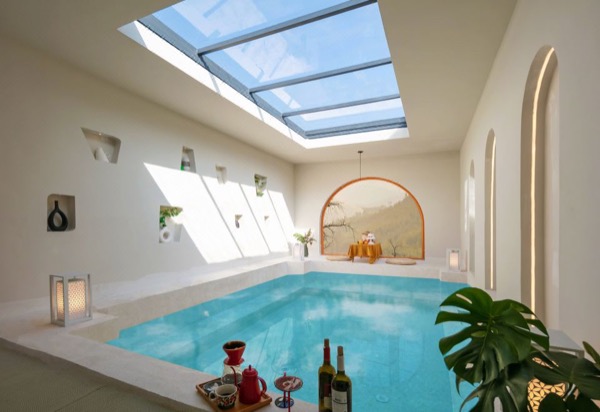
Of the 100 properties, 65 have a pool, but every one is outdoor and not a single listing states an indoor pool. Eight are explicitly adult only, and only 10 list a children pool. Daytime temperatures in the hills are in the low teens this season, and ten minutes in an outdoor pool is enough to send a child back inside. The scarce facility in the same period is a hot spring: 24 properties.
The steadier plan for that afternoon is to stay inside the property. 91 have a lawn or garden, 44 a children play area, 55 provide toys and 47 have board games and jigsaws. The working principle for travelling with children is minimise movement and maximise staying put. Three hours in the compound and the child runs out of energy exactly at dinner.
7. The return leg runs on the opposite logic
Outbound, you want the drive to land on the nap. On the way home, you want it to land before the child wakes. The two point in opposite directions.
Of the 100 properties, 90 state checkout by 12:00, and with 7 more listing 08:00-12:00 and 1 listing 07:30-12:00, 98 want you out by 12:00 or earlier. Checkout is not the same as leaving the hills: there is another 30 to 40 minutes of mountain road. Leave the yard at 12:00, reach the motorway around 12:40, add 2 hours 10 minutes toward Shanghai, and you are home around 15:00, which is exactly the afternoon nap.
Leave at 14:00 instead and you arrive at 17:00 with a child who is neither sleepy nor entertained. That is the two hours where the trip most often falls apart. So day two should run: pack the night before, eat breakfast before tidying the room, load the car at 11:40, check out at 12:00. Do not add a stop on the way home. That stacks the two most fragile hours of the trip on top of each other.
8. Seven questions that settle the route
Every judgement above comes down to what the host tells you on the phone. Ask these seven in order and you will not need another guide.
- "What street number should I navigate to? Can you send a village name I can search directly?" Do not enter the word Moganshan, which routes you to the scenic area checkpoint.
- "Which road is smoothest from the motorway, and which junction should I come off?" 89 properties are closer to Moganshan Town; only 11 should be approached via Wukang.
- "We arrive around 13:30. Can we drop luggage first? The child needs to sleep in the car until two." 99 properties hand over keys at 14:00 or later.
- "Can we have a later checkout, say 13:00?" 98 require 12:00 or earlier, and this is the single item most worth negotiating.
- "How far is the county seat, and is there a pharmacy nearby?" Median 11.4 km, furthest 20.4 km.
- "How many cars fit in the yard, and can we turn around?" Family cars tend to be larger and mountain turning space is tight.
- "Could you cook something separate for the child - noodles, steamed egg, less salt?" Only 30 properties list food for children.