Team-Building Activities Inside a Rented Villa
Our 100 verified properties leave you roughly five usable hours for organised activities. Twelve ideas that need no professional coach, sequenced by noise into three slots, plus nine questions to ask on the booking call.
1. Do the arithmetic first: you have about five hours of activity time
Most activity plans assume two days and one night equals 48 usable hours. It does not. Of our 100 verified properties, 81 release rooms only after 14:00 and 90 require check-out before 12:00, so the real timeline runs from 14:00 on Saturday to 12:00 on Sunday — 22 hours. Subtract eight hours of sleep, three hours across two main meals, an hour of room allocation and luggage, and 1.5 hours of washing and packing, and roughly eight hours remain for group activity. Remove the slow arrivals and the post-lunch lull and you are left with five to six hours that can actually be scheduled.
Those hours are not contiguous. They come in three blocks, and the 12 ideas have to be pushed into three drawers whose depth is set by the host, not by your itinerary.
- Saturday afternoon (about 3 hours, 14:30–17:30): the only block that can be outdoors, sweaty and loud. Anything physically demanding belongs here.
- Saturday evening (about 2–2.5 hours, 19:30–22:00): its length is set by the quiet-hours clause — 25 properties from 22:00, 18 from 23:00, 10 at 21:00 or earlier, 38 with no clause at all.
- Sunday morning (about 1–1.5 hours, 08:30–10:00): breakfast, packing and check-out eat most of it. Low-intensity closing only; nothing that needs a venue.
2. Sort by noise, not by mood
Almost everyone sequences a retreat as icebreaker in the afternoon, barbecue at dusk, party at night, talking until late — because the mood builds that way. In a rented villa this sequence fails, because it puts the loudest item after the quiet-hours deadline.
Thirty-five properties start quiet hours at 22:00 or earlier (10 at 21:00 or earlier, 25 at 22:00), 18 start at 23:00, and 38 set no clause. On a normal schedule the party starts at 20:30 and finishes around 23:00 — which means those 35 hosts knock on the door at your peak moment. Move the whole evening one hour earlier (dinner 19:00, party 20:00, close 21:30) and all 35 become usable.
So there is one rule: sequence loud to quiet, loud early, quiet late. It matters more than the choice of activity. Choosing badly costs you fun; sequencing badly costs you a complaint, a cleaning surcharge, or an early finish.
- Tier one, will draw a complaint: bonfire, amplified KTV, pool fights, tug of war, any sound-system-led party. Before dinner, or the first hour after it.
- Tier two, acceptable within the grounds: barbecue, lawn relay, cooking contest, photo scavenger hunt. Either side of dinner, but not past 22:00.
- Tier three, barely audible: board games, film night, drawing games, tea-room conversation. Any hour, and this is what the late slot should actually contain.
3. Five ideas with no equipment at all
These five need no venue condition and no host cooperation — paper, a phone, and people's own bodies are enough. They are the filler: for the window before everyone arrives, or when rain or heat kills the planned programme.
- Two truths and a lie | Each person states three things about themselves, one false; the group votes. Thirty minutes, works from 10 to 40 people, ideal as the first item after arrival because nobody has to stand up.
- Team names and a scoreboard | Split into three or four teams, ten minutes to name them, then turn every later activity into a scored contest. Thirty minutes of setup that decides whether the next five hours have any competitive edge at all.
- Drawing games / undercover | Pen and paper or phones, 60 minutes. Above 20 people run several tables at once, or one table plays while three watch.
- Photo scavenger hunt | Hand out a list of ten targets (find a red door, four people jumping at once), 40 minutes, and send them around the grounds. The only equipment-free item that genuinely burns energy.
- Human lettering / silent line-up | Spell the company name with bodies, or line up by birth month without speaking. Five minutes, for waiting on food, cars or latecomers.
4. Seven ideas that depend on hardware — verify every one by phone
The remaining seven depend on what the property actually has. A facility tag saying it exists and it being usable that night are two different things. Our tag counts narrow the shortlist; the phone call decides it.
- Lawn relay and tug of war | 91 properties list a lawn or garden. Do not ask whether there is a lawn; ask whether 30 people can stand on it at once. Many are ornamental.
- Barbecue relay | 86 have barbecue facilities. Three questions: who supplies charcoal and grill, can they buy the food, and what time must it stop — that last one is usually tied to quiet hours.
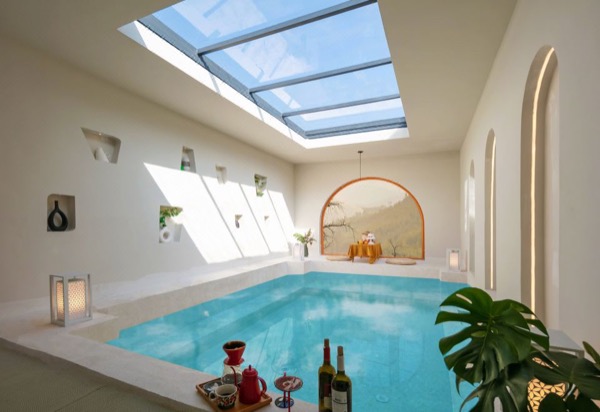
- Pool games | 65 have a pool (35 landscape, 29 infinity, 10 children's). Ask whether swimming is allowed that night, how deep it is, whether there is lighting, and whether it is heated. The word landscape means look, do not swim.
- KTV contest | 85 carry a KTV or home-cinema tag (56 list KTV explicitly, 42 list a home theatre). Ask how late it can run, whether there is a decibel limit, and how many microphones.
- Film night | 42 have a home theatre and 62 have a multimedia presentation system. Ask about projector brightness in daylight, screen size, and blackout. Projecting onto a white wall by day looks far worse than people expect.
- Cooking contest | 42 have a usable kitchen. Ask how many burners — four burners for 30 people is a crisis — whether they can all run at once, the cleaning surcharge, and who washes up.
- Bonfire | 89 carry a barbecue-bonfire tag, but a tag is not permission for an open flame. Ask whether it is real fire or electric, whether the fire-safety season forbids it, whether it must be registered, and what fuel is used.
5. Rain means changing venue, not cancelling
Mountain rain arrives fast. The usual reaction is to write off the afternoon, yet the indoor provision is enough to carry a full session: 87 properties have a meeting or multi-function space (73 a conference room, 63 a multi-function room, 62 a multimedia system), 42 have a home theatre, 18 have a games room.
The real problem is never a lack of indoor space — it is that nobody decided the substitute in advance. The wet-weather plan belongs in the itinerary agreed at booking, not in a debate held while it rains. That half hour of confusion drains a group faster than the weather.
- Lawn relay becomes balloon volleyball in the meeting room: two teams, the balloon may not touch the floor, heads and shoulders allowed.
- Photo hunt becomes indoor treasure list: ten objects around the house, photographed against a time limit.
- Pool games become board games or a murder-mystery script: 79 properties have a games room; bring the script.
- Bonfire becomes film night plus awards: the 42 home theatres are ideal for closing the whole event.
6. Headcount sets how many activities, not which ones
The same 12 ideas are far harder to run for 40 than for 20, because almost everything in a rented villa is serial: one space, one set of equipment, one group at a time. More people means longer waits, and long waits scatter a group.
Our properties sleep 10 to 75: 39 sleep 10–19, 42 sleep 20–29 (the deepest band), only 7 sleep 30–39, and 12 sleep 40 or more. Past 30 the shortlist falls off a cliff, which is why above 30 people you secure the property before designing the programme.
- 10–19 people (39 options): three activities maximum. Little serial loss, but no basis for team competition — prefer items everyone does at once.
- 20–29 people (42 options, the sweet spot): four, split into teams. The only size that supports real competition without long queues.
- 30–39 people (7 options only): three, two of them indoors or semi-indoors. With 30 people on a lawn relay, half of them are always waiting.
- 40+ people (12 options): two only, and both must run for everyone simultaneously — barbecue, film, party. Anything turn-based becomes a two-hour queue.
7. Nine questions to read straight off the page
Every judgement above has to become a specific question on the call. These nine can be read aloud — each asks whether something is possible, not whether it exists, because the tag always says it exists.
- Can the yard or lawn hold 30 people standing at once?
- How late can the sound system run, and is there a decibel limit?
- Is the bonfire or barbecue open flame or electric, and is it allowed during the fire-safety season?
- Can we swim that night, how deep is the pool, and is there lighting?
- How many burners does the kitchen have, can they all run, and what is the cleaning fee?
- Is there one table that seats the whole group? Two tables means two separate events.
- Can the meeting room be cleared of furniture, and is the projector bright enough by day?
- If it rains, how large is the indoor backup space and how many people fit?
- After 12:00 check-out on Sunday, can we still use the common areas for an hour?
8. A good retreat needs three activities, not twelve
The twelve are a reserve pool, not a running order. Retreats that work have three: one that makes people sweat (afternoon), one where everyone sits and eats together (dusk), one that needs no talking (night). Sweat builds relationships, a shared meal builds trust, silence lets people recover. The other nine are substitutes for rain, dead air and latecomers.
One counter-intuitive finding: 84 properties explicitly allow events, but only 24 of them set no quiet-hours clause at all. Permission to hold an event and permission to hold it late are different licences — the first is the host's attitude, the second is your actual running time. Ask them as two separate questions and you will get two very different answers.
Keep the order straight: draw the usable blocks from the 14:00 check-in, the 22:00 quiet hour and the 12:00 check-out, then pick three activities to fill them. Do it the other way round and even a perfect list will not run.